
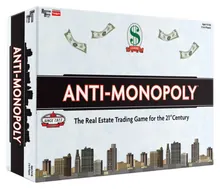
Anti-Monopoly
Two sides, two sets of rules: fair competitors against greedy monopolists
- Set-up
- About 5 min
- Reading
- Some
The quick verdict
Full verdict ↓Great for Families who grew up on Monopoly or Business and want a version with a new idea at its heart
Think twice if You want a short game: like Monopoly, a full game usually runs an hour or more
How we rate it
Learning curve. The turn is as simple as Monopoly's, but each side has its own building, rent, penalty and tax rules, so the first game needs the rules sheet close by.
Luck & skill. The dice decide where you land and what you can buy. Choosing a side, trading and when to build give some control, but luck still matters a lot.
Interaction. You pay each other rent and trade properties all game, and the two sides are working to bankrupt each other.
Set-up. Choose a Treasurer, split the players into competitors and monopolists, shuffle the two card decks and hand out 1,500 in game money each. Counting out the money takes longest.
Reading. Title cards and the Competitor and Monopolist cards have short English text, read aloud when drawn.
Learning curve: 1 = UNO or Connect 4; 3 = Catan; 5 = a heavy strategy game. These describe the experience, not an overall score.
Is Anti-Monopoly right for you?
Great if
- Families who grew up on Monopoly or Business and want a version with a new idea at its heart
- Long holiday afternoons with cousins, when nobody minds a game that runs well over an hour
- Starting a conversation with older children about fair dealing, competition and monopolies
- Groups of four or six, which split neatly into two equal sides
Skip it if
- You want a short game: like Monopoly, a full game usually runs an hour or more
- Your group dislikes dice luck and player elimination, which are still part of the game
- You simply want classic Monopoly: Hasbro's game has its own page here
How Anti-Monopoly plays
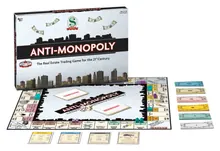
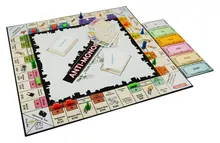
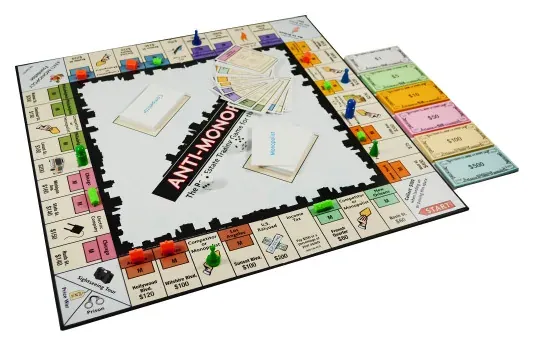
Anti-Monopoly looks like Monopoly at first glance: you roll two dice, move round the board, buy streets, transport companies and utilities, and collect rent. The big difference comes before the first roll. Players split into two equal sides, competitors and monopolists, and the two sides play by different rules all game. One player also acts as Treasurer and runs the bank.
- Time to teach: about 15 minutes.
- Reading and language: The title cards and the Competitor and Monopolist cards carry short English text, and the rules sheet is in English. A child who reads a little can play with an adult reading the cards aloud.
How to play Anti-Monopoly · Triple S Games
Choose a video · Watch right here
If this creator doesn’t allow embedded playback, watch on YouTube ↗.
A turn, step by step
- 1Roll
Roll two dice and move round the board. A double gives you one extra turn, and passing Start pays you.
- 2Buy
Buy an unowned street, transport company or utility, or pay rent to its owner: a monopolist's rent can be double a competitor's.
- 3Build
Build houses and apartments by your side's rules: competitors on any street they own, monopolists only in cities they have cornered.
- 4Win
Bankrupt everyone, or be the richest player on your side once the other side is wiped out, as agreed before the game.
The full explanation: how a game of Anti-Monopoly goes
Competitors behave like ordinary businesses. They charge normal rent, can put up to four houses (and then an apartment) on any street they own, and earn the same from transport companies however many they hold. Monopolists charge double rent once they own two streets in the same city, but they may build only in cities they have cornered, and the fares on their transport companies double with each company they add.
Each side has its own deck of cards and its own penalty corner. A competitor sent there still collects rent while waiting; a monopolist goes to Prison and collects nothing until released. Other spaces treat the sides differently too: monopolists pay a bigger share in income tax, and the Anti-Monopoly Foundation space can give competitors a small grant while monopolists pay in.
Before you start, agree how to win. In one version you play until everyone else is bankrupt. In the other, a competitor wins by being the richest competitor once every monopolist has gone bust, or a monopolist wins by being the richest monopolist once the competitors are out. The rules also give a two-hour ending in which the Treasurer goes round the board paying out rents and the player with the most cash wins.
A few smaller changes from Monopoly matter in play: a street nobody buys simply stays with the Treasurer (there are no auctions), a double gives you only one extra turn, players may not lend each other money, and passing Start pays less. The rules warn that a monopolist who gets all four transport companies is very hard to beat, so competitors should not let that happen.
What's in the box
- 1Game board
- 6Pawns
University Games' rules give competitors green pawns and monopolists blue ones - 28Title cards
one for each street, transport company and utility, with the mortgage value on the back - 25Competitor cards
- 25Monopolist cards
- 50Houses and apartments
- 2Dice
- –Paper money
- 1Instructions
From the contents list on the back of Funskool's box (Funskool's own photo). The box says 'Dice' without a number; the rules' doubles mean two. University Games' own box has wooden pieces: three green and three blue pawns, 35 houses and 15 apartments; the materials in Funskool's box were not confirmed.
Where to buy
How to make sure you get a genuine copyEditions and the details worth checking.
What reviewers and players say
Little has been written about Anti-Monopoly as a game; most articles are about Ralph Anspach's ten-year court fight with Monopoly's owners. Players in a MetaFilter discussion remember it fondly or with a shrug: one owner finds it a little more complex than Monopoly and less prone to endless laps of the board, another says it turns Monopoly's message round by rewarding the fair player, while one who played it as a child found it much the same as Monopoly. Some remember it as a game that tried to teach a lesson. Its two-sided rules are the reason to choose it over the original.
What people love
- Splitting players into competitors and monopolists gives a familiar game a new idea
- It turns Monopoly's message round: fair play can win
- The story behind it, including copies buried in a landfill, is a good talking point
- A clear choice of endings, including a two-hour game for a fixed finish
Common complaints
- Some players find it plays much like Monopoly
- The lesson about monopolies can feel heavy-handed to children who just want to play
- Dice luck and bankruptcies are still part of the game
Based on 5 reviews and discussions
- Players Why thousands of board games are buried beneath Mankato (discussion, June 2023) · MetaFilter
- Reference Minnesota's Anti-Monopoly graveyard (Curious Minnesota) · Star Tribune
- Reference Anti-Monopoly (Alfonso Lamadrid, October 2009) · Chillin'Competition
- Reference Anti-Monopoly · Wikipedia
- Reference How a fight over a board game monopolized an economist's life (October 2009) · History News Network (from The Wall Street Journal)
Summarised in our own words from the sources above. We don't use Amazon reviews or ratings.
More like Anti-Monopoly
Which game is the best fit?
Our picks if Anti-Monopoly isn't quite right.
Swipe to compare every game
| Compare the games.The details that make a difference. |
YOU’RE VIEWING
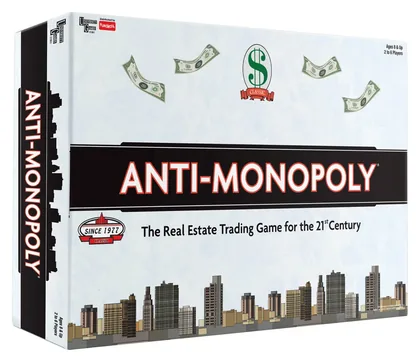 Anti-Monopoly |
ANOTHER WAY TO PLAY
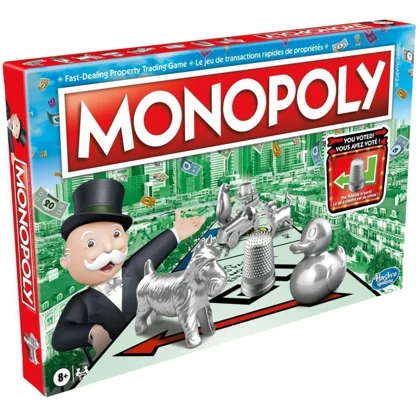 Monopoly |
ANOTHER WAY TO PLAY
 Business |
ANOTHER WAY TO PLAY
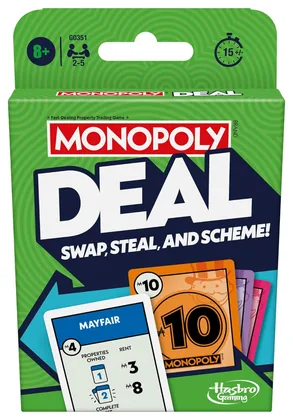 Monopoly Deal |
|---|---|---|---|---|
| Why consider it | This game Two sides, two sets of rules: fair competitors against greedy monopolists | A different fit Hasbro's original property game: one set of rules for everyone, and auctions for unsold streets | A different fit India's own roll-and-buy property game, played on Indian cities | A different fit Property and rent in a quick card game, when an hour-long board game is too much |
| Players | 2–6 | 2–6 | 2–4 | 2–5 |
| Best with | 4 | 3-4 | 3-4 | 3-5 |
| Play time | 1–3 hrs | 1–6 hrs | 1–2.5 hrs | 15–30 min |
| Age | 8+ | 8+ | 8+ | 8+ |
| Rules | Medium | Easy | Medium | Easy |
| Indian edition | Available | Imported | Available | Available |
| On this page | Explore Monopoly | Explore Business | Explore Monopoly Deal |
More from University Games
Another way into their collection.
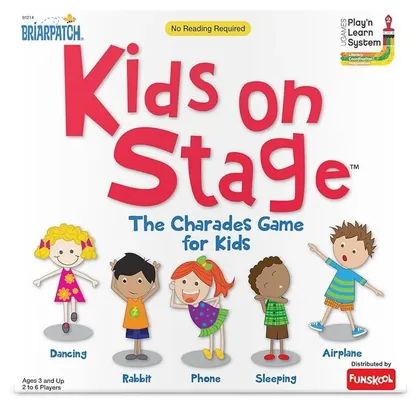
Kids On Stage
Spin, move and act it out: charades for the littlest players
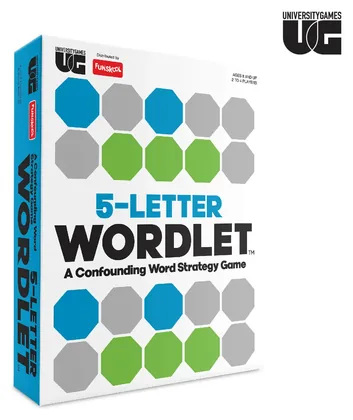
5-Letter Wordlet
Crack a secret five-letter word before anyone else, Wordle-style
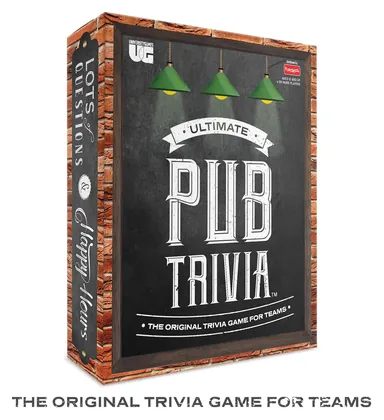
Ultimate Pub Trivia
Host a quiz night at home with 1,000 team trivia questions
More from Funskool
Also made or sold in India by Funskool.
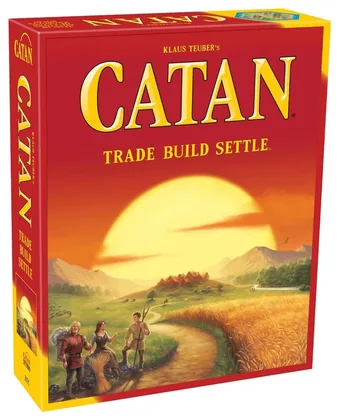
Catan
Trade wheat for brick, build roads, and race to ten points.
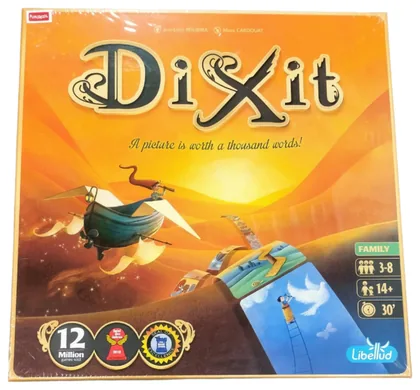
Dixit
Give a clue for a dreamlike picture, but not too obvious
Sequence
Play a card, claim its space, and make five in a row.
Rummikub
Rummy with tiles: build runs and groups, then rearrange the table
Dobble
Race to spot the one picture any two cards share
More roll-and-move games
Different games. A familiar kind of fun.
Business
India's own property game: buy cities, collect rent, build hotels
Monopoly
Roll, buy property, collect rent, and bankrupt everyone else
Monopoly Travel World Tour
Buy world destinations, stamp your travel goals, first to four wins
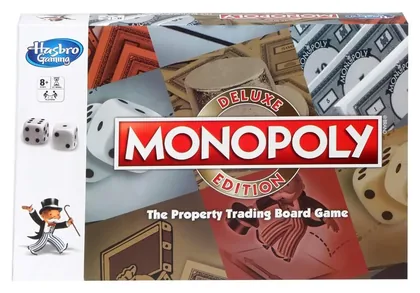
Monopoly Deluxe Edition
Classic Monopoly with wooden houses, ten tokens and a banker's tray

Monopoly Grab and Go
Buy, build and bankrupt on a small board that packs away
Also playable with two
For game nights with two players.

Monopoly Junior
Monopoly for little ones: one die, simple rules, half an hour

Monopoly Junior: Peppa Pig Edition
Monopoly Junior with Pig family tokens and places from Peppa's world
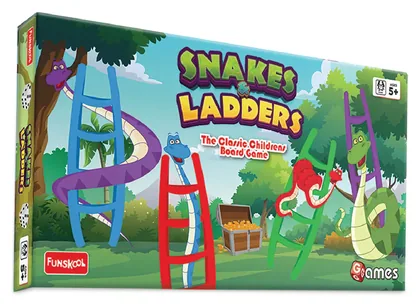
Snakes and Ladders
Climb the ladders, dodge the snakes, first to 100 wins
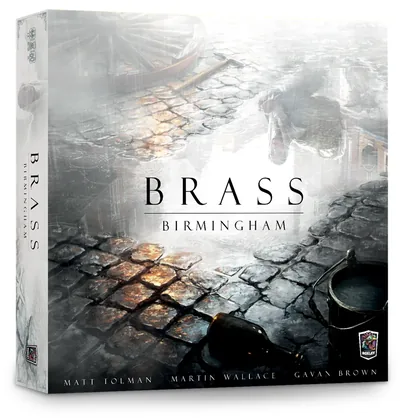
Brass: Birmingham
Build canals, railways and industries across Industrial Revolution England
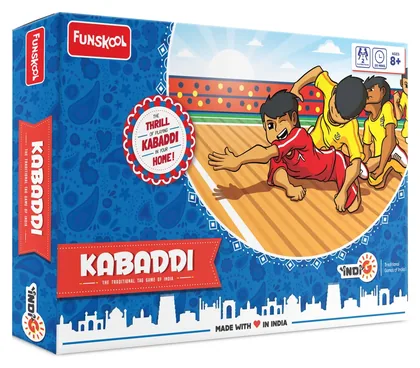
Kabaddi
Raid, tag and tackle in a two-player board game of kabaddi
Questions people ask about Anti-Monopoly
Is Anti-Monopoly the same as Monopoly?
No. Anti-Monopoly is a separate game by Ralph Anspach, published by University Games and made in India by Funskool. It uses a similar board of streets and rents, but players split into competitors and monopolists who follow different rules, and there are no Chance or Community Chest cards. Hasbro's Monopoly has its own page here.
Who makes Anti-Monopoly?
Economics professor Ralph Anspach created it in 1973, and University Games publishes it today. Funskool makes this box in India under licence. University Games' rules sheet says the Anti-Monopoly name is a Hasbro trademark used under licence, the result of a long court fight over the word 'monopoly'.
How do you win Anti-Monopoly?
Agree before you start. You can play until one player has bankrupted everyone, or until one side is wiped out, when the richest player on the other side wins. For a fixed finish, the rules also give a two-hour game in which the Treasurer pays out rents and the player with the most cash wins.
Why is it called Anti-Monopoly?
Ralph Anspach made it in 1973 because he felt Monopoly rewarded something that hurts people in real life. Monopoly's owners sued him over the name in 1974, and in 1977 a court ordered unsold copies destroyed; about 40,000 were buried in a landfill in Minnesota. Anspach won in the end and kept the name.
Is Anti-Monopoly good for children?
The box says 8 and up. The turn is as simple as Monopoly's, but children have to remember which rules their side follows, and income tax can be a percentage of what you own, so younger players need an adult as Treasurer. It is a good way to talk about fair play and competition.
Game facts
- Designed by
- Ralph Anspach
- Publisher
- University Games (the game is © Ralph Anspach; the Anti-Monopoly name is used under licence); this box is made in India by Funskool
- In India
- Funskool (India) Ltd, Chennai, which makes and sells this edition in India and lists it under University Games
- First published
- 1973
- Players
- 2–6
- Barcode
- 8901383498809
- Language
- Some English – The title cards and the Competitor and Monopolist cards carry short English text, and the rules sheet is in English. A child who reads a little can play with an adult reading the cards aloud.
Sources & photo creditsThe references behind this guide.
Facts on this page come from the publisher, the Indian maker or distributor, and the sources below. Photos are credited under each one.
- Funskool - Anti-Monopoly (product code 4988000)
- University Games - Anti-Monopoly (contents, ages, players)
- University Games - Anti-Monopoly instructions (PDF, 6 pages)
- Anti-Monopoly - Wikipedia
- Star Tribune - Minnesota's Anti-Monopoly graveyard (Curious Minnesota)
- Chillin'Competition - Anti-Monopoly (Alfonso Lamadrid, October 2009)
- History News Network - How a fight over a board game monopolized an economist's life (from The Wall Street Journal, October 2009)
- Toycra - Funskool Anti-Monopoly (SKU 4988000, barcode)
- MetaFilter - Why thousands of board games are buried beneath Mankato (June 2023)