
- Set-up
- About 3 min
- Reading
- Little
The quick verdict
Full verdict ↓Great for Children of 8 to 12 who follow kabaddi or the Pro Kabaddi League and want to play it at the table
Think twice if You want a game for the whole family at once: it's for two players or two teams
How we rate it
Learning curve. Roll, move and compare two numbers. Choosing your 10 players and which defenders to move adds a little thinking. It sits with Ludo and Qwicket on our scale.
Luck & skill. The die decides how far the raider and defenders move, and action cards add more chance. Picking strong raiders and sharing out the defenders' moves well gives you some say.
Interaction. It's head to head on every raid: one side attacks, the other defends, and every point comes from the other player.
Set-up. Each player takes a colour, picks 10 of their 15 player cards (7 to play, 3 substitutes) and sets out pawns; the action cards are shuffled. About 3 minutes once you know the game.
Reading. Mostly numbers and role names on the player cards, plus short English text on the action cards.
Learning curve: 1 = UNO or Connect 4; 3 = Catan; 5 = a heavy strategy game. These describe the experience, not an overall score.
Is Kabaddi right for you?
Great if
- Children of 8 to 12 who follow kabaddi or the Pro Kabaddi League and want to play it at the table
- Two players: siblings, or a parent and child on a rainy afternoon
- Explaining the sport's ideas (raids, tackles, the bonus area, empty raids) to children who are just getting into it
- A small gift that celebrates an Indian sport, alongside Funskool's Kho-Kho board game
Skip it if
- You want a game for the whole family at once: it's for two players or two teams
- You want strategy: the die decides how far everyone moves, and card scores decide most raids
How Kabaddi plays
Set-up: one player takes the red team and the other the yellow, each with 15 player cards and 15 matching pawns. Every card has a Raid score and a Defence score and is marked as a raider, a defender or an all-rounder. From your 15 cards you pick 10: seven to play and three substitutes, just as a real kabaddi side has seven on the mat. Your pawns stand on your half of the court.
- Time to teach: about 10 minutes.
- Reading and language: The player cards show role names (Raider, Defender, All Rounder) and two scores, so mostly you read numbers. The action cards and the rules sheet are in English. Once someone has explained the rules, children can play in Hindi, Tamil or any language.
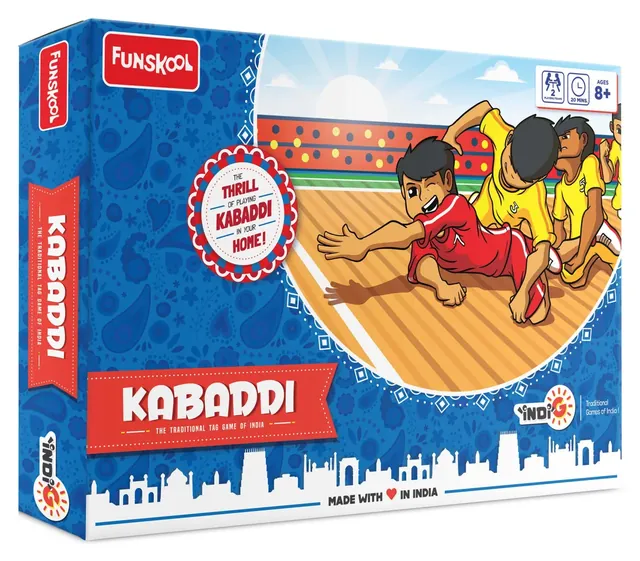
How to play Kabaddi Board game · Leisure squeezer
Choose a video · Watch right here
If this creator doesn’t allow embedded playback, watch on YouTube ↗.
A turn, step by step
- 1Raid
Choose a raider, place the pawn in the middle zone, call 'Kabaddi!' and roll the die to move into the other half.
- 2Defend
The defenders move the same number of spaces between them, trying to stand right next to the raider.
- 3Compare
The raider's Raid score takes on the total Defence score of the defenders around them. The winner scores, and whoever loses goes to the sitting block.
- 4Win
After two rounds, the side with more points wins.
The full explanation: how a game of Kabaddi goes
The youngest player raids first. Choose one of your players as the raider, put the pawn in the middle zone, call out 'Kabaddi!' and roll the die. The raider moves that many spaces into the other half, forward, left or right.
The defending side then moves the same number of spaces, with one defender or shared among several, to reach a spot right next to the raider: in front, behind or to either side. Add up the Defence scores of the defenders around the raider and compare them with the raider's Raid score. If the raider is stronger, the raid succeeds: the raider scores a point for each defender caught, they go to the sitting block, and the raider goes home. If the defenders are stronger, the raider is out. If no defender can reach the raider, it's an empty raid.
Special squares add surprises. 'Pick a card' gives you an action card, such as an extra point if the raid succeeds, while 'Raiders +10' and 'Defenders +10' add 10 to a player's score. The two sides take turns to raid, and after two rounds the player with more points wins.
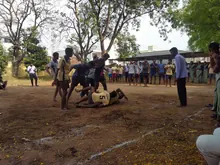
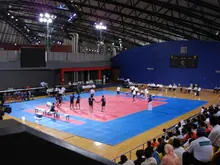
About the sport: in real kabaddi, each side has seven players on the court, and a raider crosses the middle line chanting 'kabaddi' without a break, trying to tag defenders and get back safely. India's Pro Kabaddi League has been running since 2014. The board game borrows the raids, tackles, bonus points and empty raids, so it's a handy way to explain the terms to children who are starting to watch matches.
What's in the box
- 1Gameboard
a kabaddi court with a middle zone, bonus areas, a sitting block and special squares (Pick a card, Raiders +10, Defenders +10) - 15Red team player cards
each with a Raid score and a Defence score, marked Raider, Defender or All Rounder - 15Yellow team player cards
- 18Action cards
- 15Red pawns
- 15Yellow pawns
- 1Die
- 1Instruction sheet
English
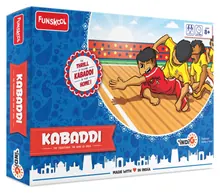
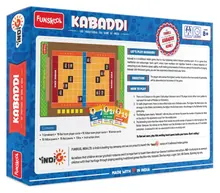
This list comes from the contents panel on Funskool's own photo of the box back (item 9547200), and it adds up to 81 pieces, the count the listing gives. A January 2023 how-to video of the same box lists the same parts. The board's labels come from the box photo and the video.
Where to buy
How to make sure you get a genuine copyEditions and the details worth checking.
What reviewers and players say
We found no independent written review of Funskool's Kabaddi. A short English how-to video shows a game that is quick to learn: roll, move and compare a Raid score with a Defence score, with action cards and +10 squares for surprises. Funskool's Philip Royappan said in a 2024 interview that traditional board games such as Kabaddi and Lagori have been consistent performers for the company, which points to steady sales rather than a review. Expect a light, luck-driven game for two that gets children talking about raids and tackles.
What people love
- It uses the sport's own ideas: raids, tackles, the bonus area and empty raids
- Quick to learn: roll, move, then compare a Raid score with a Defence score
- Action cards and +10 squares keep raids from being predictable
Common complaints
- Only two sides, so it isn't a game for a big family group
- The die decides how far everyone moves, so luck plays a big part
Based on 4 reviews and discussions
- Reference How to play Kabaddi Board game (Leisure squeezer, January 2023) · YouTube - Leisure squeezer
- Reference Our proposition is to offer a wide range of quality toys: Philip Royappan, Funskool (October 2024) · exchange4media
- Reference Funskool India Ltd. launches 40 new products across various categories (press release, April 2021) · AP7AM
- Reference Kabbadi product page and box photos (Funskool, undated) · Funskool
Summarised in our own words from the sources above. We don't use Amazon reviews or ratings.
More like Kabaddi
Which game is the best fit?
Our picks if Kabaddi isn't quite right.
Swipe to compare every game
| Compare the games.The details that make a difference. |
YOU’RE VIEWING
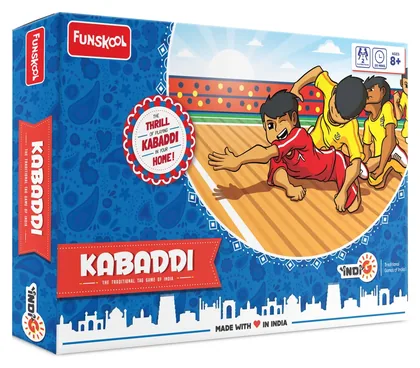 Kabaddi |
ANOTHER WAY TO PLAY
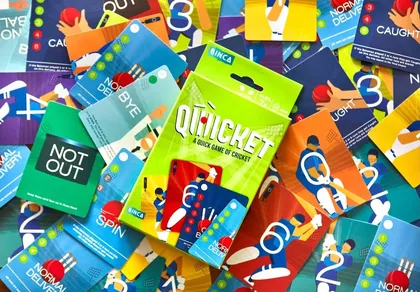 Qwicket |
ANOTHER WAY TO PLAY
 Ludo |
|---|---|---|---|
| Why consider it | This game Raid, tag and tackle in a two-player board game of kabaddi | A different fit Another two-player sports duel, cricket this time, played with cards | A different fit The Indian family classic: roll the die, move your pieces and send rivals home |
| Players | 2 | 2 | 2–4 |
| Best with | 2 | 2 | 4 |
| Play time | 20–30 min | 5–10 min | 30–60 min |
| Age | 8+ | 7+ | 5+ |
| Rules | Easy | Easy | Easy |
| Indian edition | Available | Available | Available |
| On this page | Explore Qwicket | Explore Ludo |
More from Funskool
Another way into their collection.
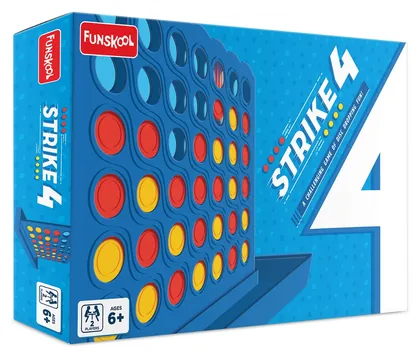
Strike 4
Drop discs, block your rival and line up four first
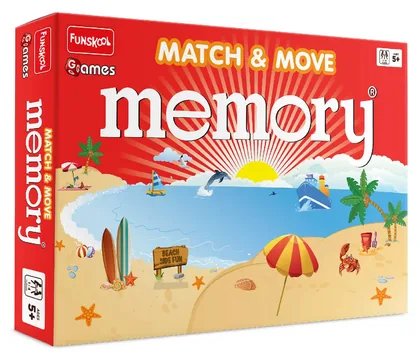
Match & Move Memory
Remember where each picture hides and race your piece home
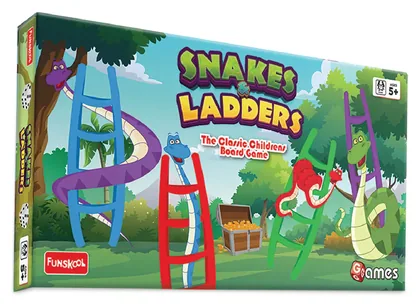
Snakes and Ladders
Climb the ladders, dodge the snakes, first to 100 wins
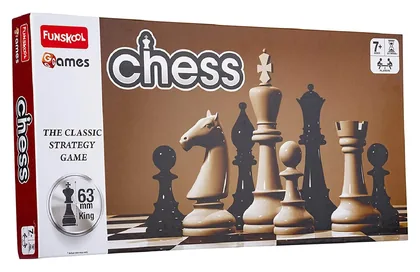
Chess
The two-player battle of wits that began in India as chaturanga
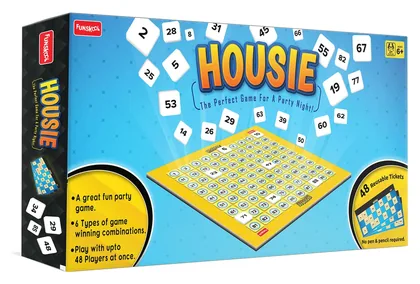
Housie (Tambola)
Strike off called numbers and shout first for lines and Full House
More dice games
Different games. A familiar kind of fun.
Ludo
India's favourite race game: roll a six, cut and race home
Snakes and Ladders
Climb the ladders, dodge the snakes, first to 100 wins

Monopoly Junior
Monopoly for little ones: one die, simple rules, half an hour

Trouble
Pop the bubble, race four pegs home and bump your rivals

Monopoly Junior: Peppa Pig Edition
Monopoly Junior with Pig family tokens and places from Peppa's world
Also worth a look (not in our catalogue yet): Kho-Kho (Funskool board game) – The other tag sport in Funskool's Traditional Games of India range, also for two.
Questions people ask about Kabaddi
How do you play the Kabaddi board game?
Each side picks seven players and three substitutes from its 15 player cards. On a raid, you roll the die and move your raider into the other half; the defenders move the same number of spaces to surround the raider. Then you compare the raider's Raid score with the defenders' total Defence score, and the stronger side wins the raid. After two rounds, the player with more points wins.
How many players can play Funskool's Kabaddi?
Two. The rules are written for two players, one with the red team and one with the yellow, and the box marks it for 2 players or teams, so brothers and sisters can team up on one side.
Is Funskool's Kabaddi made in India?
Yes. The box carries a 'Made in India' badge, and Funskool gives India as the country of origin on its product page. It belongs to Funskool's Traditional Games of India range, which Funskool announced in 2021.
What age is the Kabaddi board game for?
Funskool says 8 and up. Younger children can roll and move with help, but choosing a raider, moving defenders and comparing scores suits children from about 8.
What other traditional Indian games does Funskool make?
The same range includes a Kho-Kho board game, and the Kabaddi box names Chathuranga, Lagori, Goli, Gilli Danda and spinning tops among Funskool's traditional games. Some of them, like Lagori, are outdoor games rather than board games.
Game facts
- Publisher
- Funskool
- In India
- Funskool (India) Ltd, Chennai, which makes and sells it
- First published
- 2021
- Players
- 2 players; the box marks it for 2 players or teams
- Language
- Little reading – The player cards show role names (Raider, Defender, All Rounder) and two scores, so mostly you read numbers. The action cards and the rules sheet are in English. Once someone has explained the rules, children can play in Hindi, Tamil or any language.
Sources & photo creditsThe references behind this guide.
Facts on this page come from the publisher, the Indian maker or distributor, and the sources below. Photos are credited under each one.
- Funskool - Kabbadi product page (item 9547200)
- Funskool - Kho-kho product page (item 9547100)
- How to play Kabaddi Board game (Leisure squeezer, YouTube, January 2023)
- AP7AM - Funskool India Ltd. launches 40 new products across various categories (April 2021)
- exchange4media - Our proposition is to offer a wide range of quality toys: Philip Royappan, Funskool (October 2024)
- Olympics.com - Kabaddi: How to play India's 4000-year-old indigenous sport