

- Set-up
- About 5 min
- Reading
- Little
The quick verdict
Full verdict ↓Great for Energetic 4- to 8-year-olds on rainy days and long school holidays, when they need to burn off energy
Think twice if You only have a small, crowded room; the game needs a clear run of floor several metres long
How we rate it
Learning curve. Roll, toss a stone, jump and don't touch the floor: a four-year-old gets it in one go, so it sits with UNO at 1 on our scale. The number-card challenges can be made harder for older children.
Luck & skill. The dice decide how far you go and which stone you use; good throws and steady balance help, but it is mostly a fun race.
Interaction. Children race side by side and cheer each other on, and the team games have them help each other across; nobody can block anyone.
Set-up. Clear a long stretch of floor, mark a start and a finish line, hand out the stones and test that they grip the floor.
Reading. Children only need to recognise the numbers 1 to 9; an adult reads the activity guide and calls out the challenges.
Learning curve: 1 = UNO or Connect 4; 3 = Catan; 5 = a heavy strategy game. These describe the experience, not an overall score.
Is Stepping Stones right for you?
Great if
- Energetic 4- to 8-year-olds on rainy days and long school holidays, when they need to burn off energy
- Birthday parties and playdates, with children racing one by one or in teams
- Parents and teachers who want to sneak in counting, odd and even numbers and simple adding
- Classrooms, activity rooms and terraces with a clear stretch of floor
Skip it if
- You only have a small, crowded room; the game needs a clear run of floor several metres long
- Your only play space is a slippery polished floor and you can't play outdoors or on a surface where the mats grip
- You want a quiet sit-down game for the table
How Stepping Stones plays
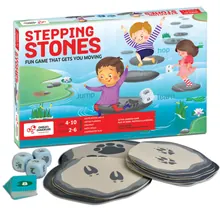
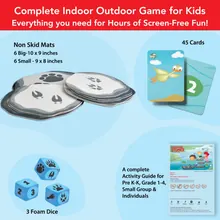
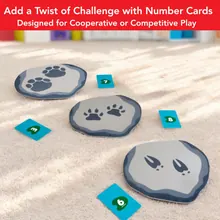
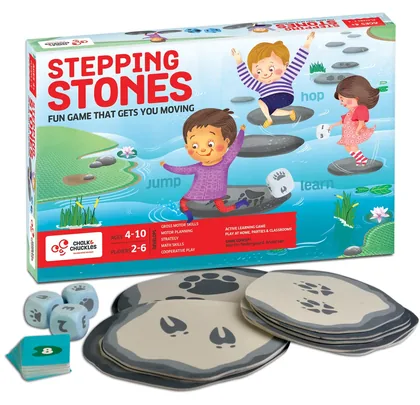
Agree on a start line and a finish line: one end of a hall to the other, across a terrace or along a garden path. The box has 12 foam stepping stones, six small and six large, marked with animal footprints (fox, tiger, rabbit, elephant, bear and deer), and three foam dice: a number die and two animal-footprint dice.
- Time to teach: about 5 minutes.
- Reading and language: Play is about jumping, the numbers 1 to 9 and animal footprints, so children don't need to read. The activity guide is in English, so an adult reads out the rules and calls the number challenges, in whatever language the family speaks.
Stepping Stones by Chalk and Chuckles · Chalk and Chuckles · Official
If this creator doesn’t allow embedded playback, watch on YouTube ↗.
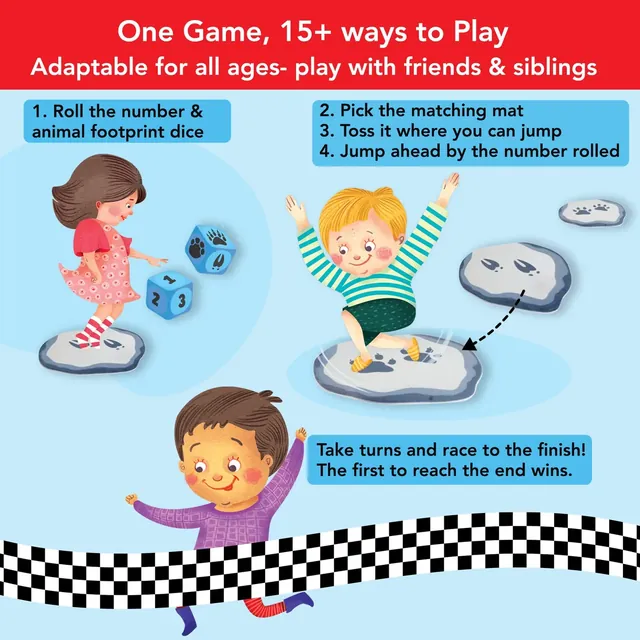
A turn, step by step
- 1Roll
Roll the foam dice: the number says how far you go, and the footprint shows which stone to use.
- 2Jump
Toss the stone ahead, jump onto it and balance, moving stone to stone without touching the floor.
- 3Win
The first player to reach the agreed finish line wins the race.
The full explanation: how a game of Stepping Stones goes
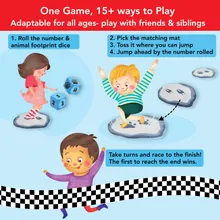
In the basic race, a turn goes like this, according to the maker's picture guide: roll the number die and an animal die, pick the stone with the matching footprint, toss it ahead to where you can jump, and jump ahead by the number rolled. Land on the stones and balance there; the one rule nobody forgets is that you must not step on the floor. The first player to reach the finish line wins.
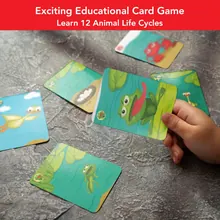
The 45 cards are printed on both sides. One side has the numbers 1 to 9, in five sets, for maths games: spread cards on the floor and let children collect only the ones that fit a challenge, from simply finding a number for 3- and 4-year-olds to odd and even, bigger and smaller, or adding for older children. The other side shows the life cycles of 11 marshland animals, four cards each, for a calmer card game at the table. The maker says the activity guide has more than 15 ways to play, including team and cooperative games.
For parents: you need a clear strip of floor several metres long, away from furniture corners, stairs and anything breakable; a terrace, a park, a driveway or a big room with the sofa pushed back all work. The maker calls the foam mats non-skid, but test one on your floor before anyone jumps: they grip best on a dry, clean surface, and very polished marble or tiles can still be slippery. Bare feet or shoes with grip are safer than socks. Keep the jumps short for the youngest, and stay close to call out the rules and settle who touched the floor.
What's in the box
- 12Foam stepping stones
non-skid mats with animal footprints: 6 small (about 23 x 20 cm) and 6 large (about 25 x 23 cm) - 45Cards
printed on both sides: numbers 1 to 9 on the front, animal life cycles on the back - 3Foam dice
1 number die and 2 animal-footprint dice - 1Activity guide
rules for the race, number games, team games and the card game
Box: 38.1 × 22.9 × 4.3 cm, 0.49 kg. Handy to know for gifting and travel.
Contents are from Chalk and Chuckles' product page for the box we link (item code CCPPL037): 12 stepping stones in 6 sets of 2, 45 number cards, 3 foam dice and an activity guide. The stone sizes, the two sides of the cards and the split of the dice come from the maker's contents picture, which shows a page of the activity guide. The listing behind our Amazon.in link gives the same list.
Where to buy
How to make sure you get a genuine copyEditions and the details worth checking.
What reviewers and players say
We found no independent reviews, parenting blogs, forum threads or award pages for Stepping Stones, although the maker posted a video of it in 2016. So this page rests on Chalk and Chuckles' own product page, pictures and video. On paper it is a lively, screen-free game for young children that mixes jumping and balance with simple number work. How well it works depends on having enough space and a floor the foam mats grip, and on an adult setting up the course.
What people love
- Gets young children moving indoors on rainy days, with no screens
- One box covers a jumping race, number games, team games and a card game
- Children don't need to read, so cousins of different ages can play together
- Works outdoors too, on a terrace, in a park or on a driveway
Common complaints
- Needs far more space than a table game, and an adult to set it up and watch
- Foam mats can still slip on polished or dusty floors, so test them first
- The rules online are brief, so keep the printed activity guide
4 research sources
- Reference Stepping Stones (Chalk and Chuckles product page, October 2026) · Chalk and Chuckles
- Reference Stepping Stones by Chalk and Chuckles (maker's video and description, December 2016) · YouTube (Chalk and Chuckles)
- Reference Chalk & Chuckles Stepping Stones Game (US distributor listing, December 2024) · Safari Ltd
- Reference Contact: registered office and factory address (Chalk and Chuckles) · Chalk and Chuckles
Summarised in our own words from the sources above. We don't use Amazon reviews or ratings.
More like Stepping Stones
Which game is the best fit?
Our picks if Stepping Stones isn't quite right.
Swipe to compare every game
| Compare the games.The details that make a difference. |
YOU’RE VIEWING
 Stepping Stones |
ANOTHER WAY TO PLAY
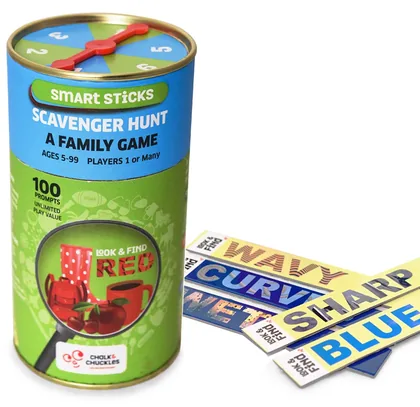 Smart Sticks Scavenger Hunt |
ANOTHER WAY TO PLAY
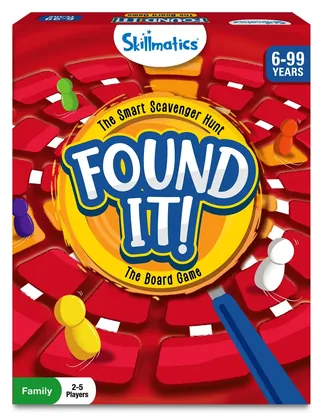 Found It! Board Game |
ANOTHER WAY TO PLAY
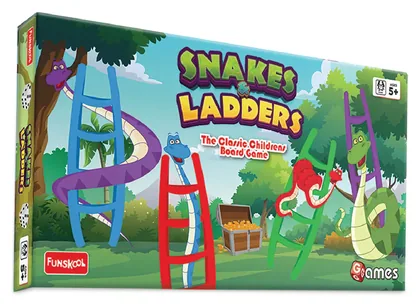 Snakes and Ladders |
|---|---|---|---|---|
| Why consider it | This game Throw a foam stone, jump onto it and race to the finish | A different fit Same maker; another game that gets young children up and moving around the house | A different fit A hunt-and-find game that sends children round the home instead of sitting at the table | A different fit The same roll-and-race idea for young children, played sitting down on a board |
| Players | 2–6 | 1+ | 2–5 | 2–4 |
| Best with | 3-4 | 2-4 | 3-5 | 2-4 |
| Play time | 10–30 min | 10–30 min | 15–20 min | 15–30 min |
| Age | 4+ | 5+ | 6+ | 5+ |
| Rules | Easy | Easy | Easy | Easy |
| Indian edition | Available | Available | Available | Available |
| On this page | Explore Smart Sticks Scavenger Hunt | Explore Found It! Board Game | Explore Snakes and Ladders |
More from Chalk and Chuckles
Another way into their collection.
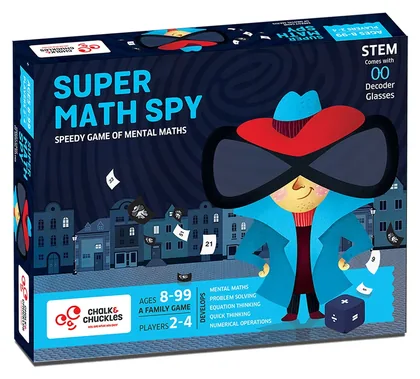
Super Math Spy
Race to build an equation that hits your mission number
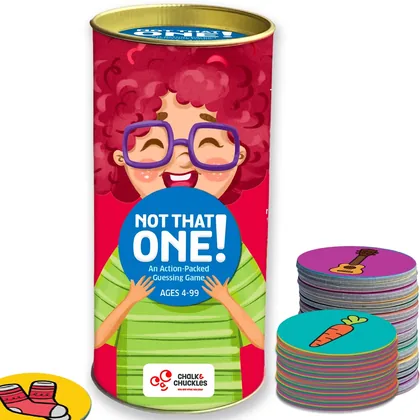
Not That One
Ask yes-or-no questions, grab tokens, and dodge the secret one
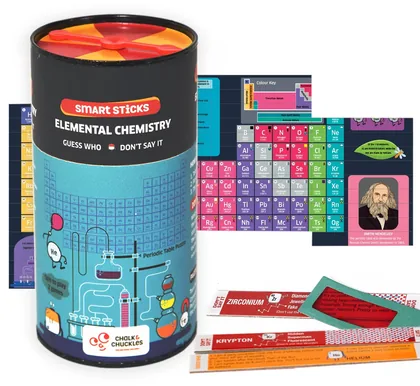
Smart Sticks Elemental Chemistry
Spin, pick a stick and race to name the element
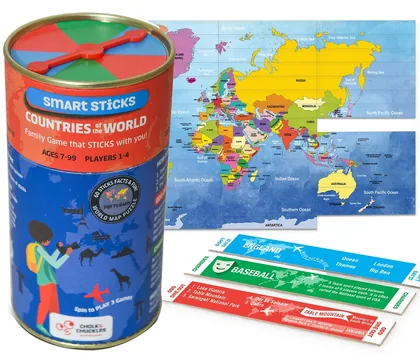
Smart Sticks Countries of the World
Act, describe and spot the odd one out across 60 countries
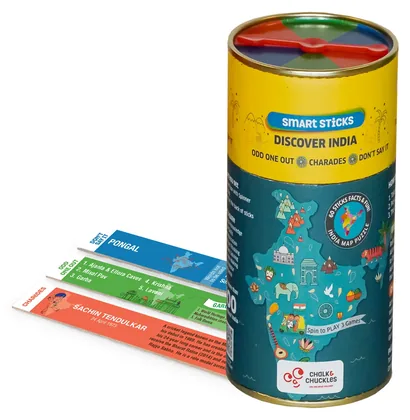
Smart Sticks Discover India
Charades, clues and odd-one-out rounds about India, plus a map puzzle
More steady-hands games
Different games. A familiar kind of fun.
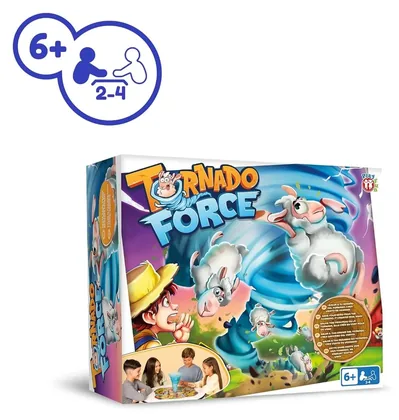
Tornado Force
Race your sheep home before the tornado sweeps them away

Jenga
Pull a block, stack it on top, don't topple the tower
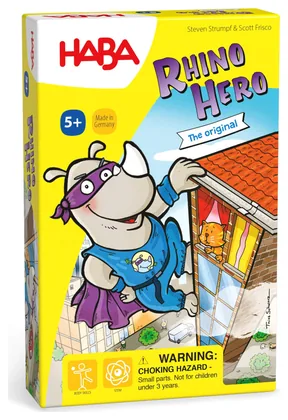
Rhino Hero
Build a wobbly card skyscraper without toppling the rhino
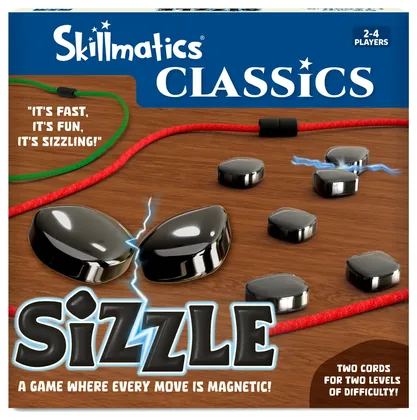
Sizzle
Place magnets inside a loop without letting them snap together.
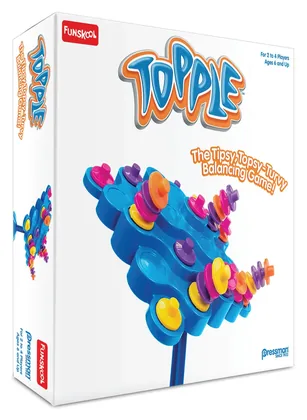
Topple
Roll, stack and score on a tower that tips and sways
Also playable with two
For game nights with two players.
Sizzle
Place magnets inside a loop without letting them snap together.
Snakes and Ladders
Climb the ladders, dodge the snakes, first to 100 wins
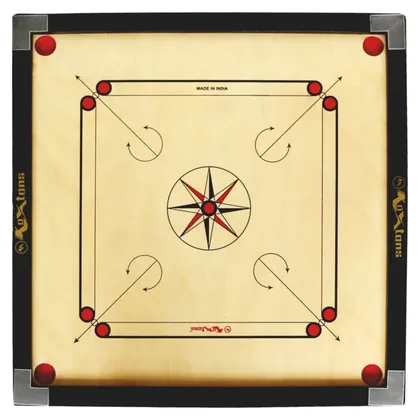
Carrom
Flick the striker, pocket your colour, then capture and cover the queen
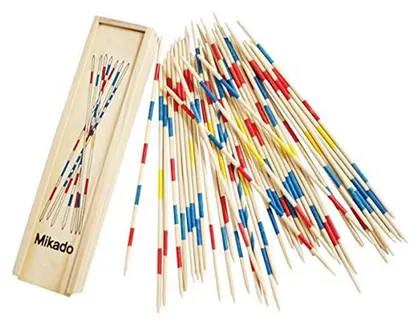
Mikado
Drop the sticks, then lift them one by one without a wobble
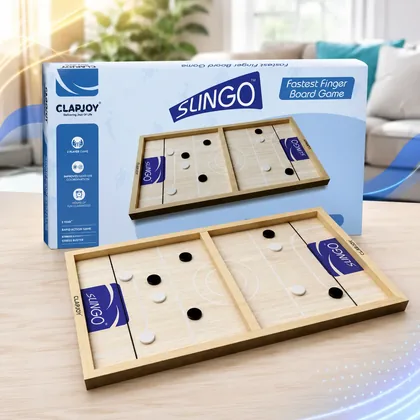
Sling Puck
Two players, ten pucks, one slot: clear your side first
Questions people ask about Stepping Stones
What age is Stepping Stones for?
The maker's page says 4 to 8 years, and the box front gives 4 to 10. Four-year-olds can join the jumping race with an adult nearby, and the number-card challenges keep children of up to about 8 interested as they practise odd and even numbers and simple adding.
How much space do you need for Stepping Stones?
Much more than for a table game: a clear strip of floor several metres long, such as a hall, a terrace, a park or a driveway, or a big room with the furniture pushed back. The stones are about 20 to 25 cm across, and children throw them ahead and jump onto them, so leave room on both sides too.
Are the Stepping Stones mats safe on tiled or marble floors?
The maker describes the foam mats as non-skid, made for children to jump on safely. Even so, test a mat on your floor first, because dust, water or highly polished stone can make any mat slide. Play on a dry floor, away from sharp corners and stairs, and keep an adult nearby for younger children.
How many children can play Stepping Stones?
The box and the maker's page say 2 to 6 players, and the listing behind our Amazon.in link says up to 10. Bigger groups can play in teams and take turns to jump.
Is Stepping Stones made in India?
It comes from Chalk and Chuckles, an Indian company with its own factory in Kundli, Haryana, and the listing behind our Amazon.in link gives India as the country of origin. The maker's own pages don't say where this box is made, so we don't mark it made in India.
Game facts
- Designed by
- Martin Nedergaard Andersen
- Publisher
- Chalk and Chuckles (Chalk and Chuckles Products Pvt Ltd, New Delhi, India)
- In India
- Chalk and Chuckles, an Indian company (registered office in New Delhi, factory in Kundli, Haryana) that designs and sells the game in India
- Players
- The box and the maker's page say 2 to 6 players, and the box has six pairs of stones. The listing behind our Amazon.in link says up to 10, which works when a bigger group plays in teams and takes turns. The maker also says the activity guide works for small groups and for one child.
- Barcode
- 8906045560375
- Language
- Little reading – Play is about jumping, the numbers 1 to 9 and animal footprints, so children don't need to read. The activity guide is in English, so an adult reads out the rules and calls the number challenges, in whatever language the family speaks.
- Box size and weight
- 38.1 × 22.9 × 4.3 cm, 0.49 kg
Sources & photo creditsThe references behind this guide.
Facts on this page come from the publisher, the Indian maker or distributor, and the sources below. Photos are credited under each one.
- Chalk and Chuckles - Stepping Stones (contents, how to play, size)
- Chalk and Chuckles - Contact (registered office and factory address)
- Chalk and Chuckles - Stepping Stones by Chalk and Chuckles (maker's video, December 2016)
- Safari Ltd - Chalk & Chuckles Stepping Stones Game (US distributor: barcode, contents, age, box size)