
- Set-up
- About 2 min
- Reading
- None
The quick verdict
Full verdict ↓Great for Families who grew up on Ludo and want to try the older, richer game it came from
Think twice if You want a quick game: a full game of Pachisi can run close to an hour or more
How we rate it
Learning curve. Harder than Ludo: the cowrie scores, grace throws and castle squares take a few minutes to learn, but every turn is just throw and move.
Luck & skill. The shells decide a lot, but you choose which piece to move, when to wait on a castle and how to help your partner, and that matters over a long game.
Interaction. You capture opponents' pieces, block with your own and play as a team with the partner opposite you.
Set-up. Spread the cloth, pick colours and teams, and put every piece in the centre. Agree the cowrie scores and house rules first.
Reading. Nothing to read; only the cowrie scores to remember.
Learning curve: 1 = UNO or Connect 4; 3 = Catan; 5 = a heavy strategy game. These describe the experience, not an overall score.
Amazon Prime Get fast, free delivery on eligible items and early access to select sales. See Prime plans ↗
Is Pachisi (Chaupar) right for you?
Great if
- Families who grew up on Ludo and want to try the older, richer game it came from
- Four players in two teams: partners sit opposite each other and work together to get all their pieces home
- Long, chatty afternoons at family get-togethers, Diwali holidays or a house full of cousins
- A heritage gift: a cloth board folds flat and packs into a bag for a trip to the grandparents
Skip it if
- You want a quick game: a full game of Pachisi can run close to an hour or more
- Your children are very young: counting the cowrie throws and choosing which piece to move suits about 6 and up
- You want pure strategy: the cowrie throws decide a lot, as in Ludo
How Pachisi (Chaupar) plays
Pachisi and Chaupar are India's great cross-shaped race games, traditionally played on embroidered cloth boards. Their age is often overstated. Many people link them to the famous dice game in the Mahabharata, but the games historian Irving Finkel points out that the epic's descriptions don't match this game. Better evidence comes from the Mughal period: a 19th-century traveller, Louis Rousselet, wrote that the emperor Akbar played Pachisi 'in a truly regal manner' on palace courtyards laid out as boards, with people as the pieces, and a paved courtyard known as the Pachisi Court can still be seen at Fatehpur Sikri. The name comes from pachis, Hindi for twenty-five, the top throw.
- Time to teach: about 10 minutes.
- Reading and language: Nothing to read: you count cowrie shells and move pieces. The only thing to learn is what each throw scores, and that can be written on a slip of paper in any language.
How to Play Pachisi · Taming Games
Choose a video · Watch right here
If this creator doesn’t allow embedded playback, watch on YouTube ↗.
A turn, step by step
- 1Throw
Throw six cowrie shells and count the mouths facing up: 2 to 5 move that many, six up is 6, one up is 10 and none up is 25. A 6, 10 or 25 lets you throw again.
- 2Move
Use a 6, 10 or 25 to bring a piece out of the centre, or move a piece already out: down your own arm, anticlockwise round the outside, then back up to the centre.
- 3Capture
Land on an opponent's piece on an ordinary square to send it back to the centre. Pieces on the marked castle squares are safe.
- 4Win
Bring each piece into the centre with an exact throw. A team wins when both partners have all their pieces home.
The full explanation: how a game of Pachisi (Chaupar) goes
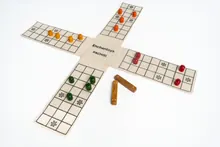
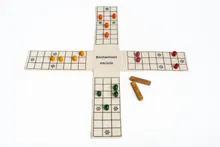
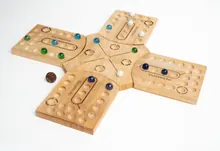
The board is a cross with four arms, each three columns of eight squares, around a big central square, the charkoni, where pieces start and finish. Some squares on each arm, usually marked with a cross or a flower, are castles: a piece on a castle can't be captured. Most often four people play in two teams, with partners sitting opposite each other (yellow and black against red and green in the classic colours), and each player has four pieces. Two people can play by taking two colours each.
Instead of dice you throw six cowrie shells and count how many land with the mouth (the slit) facing up. Two, three, four or five mouths up move that many squares; six up scores 6, one up scores 10, and none up scores 25. A 6, 10 or 25 is a grace throw: it gives you another throw, and in most rules you need one to bring a piece out of the centre onto the board (some let your first piece out on any throw). Some families throw seven shells, which have their own scores (adding throws such as 7, 14, 25 and 30), so agree on the table before you start.
Each piece leaves the centre down the middle column of its own arm, travels anticlockwise right round the outside of the board, then comes back up the middle column to the centre. Land on an opponent's piece on an ordinary square and you capture it: it goes back to the centre and needs a grace throw to come out again, and you usually throw again. Your own pieces may share a square, and you can't land on a castle where an opponent sits. A piece needs an exact throw to finish. In a team game the partnership wins only when both partners have all eight pieces home, so a player who finishes early may send a piece round again to help; playing alone, the first with all four pieces home wins. Some families add a rule that you must capture at least once before any of your pieces may go home.
Chaupar (Chausar) uses the same board with long four-sided dice instead of cowries, and its rules change from region to region: in Roll the Dice's southern Karnataka rules for Pagade, two long dice are marked 1, 3, 4 and 6, pieces start on the board, and you may split the two dice between two pieces. Ludo, patented in England in the late 19th century, is the simplified version: one ordinary die, a six to come out, and every player for themselves. A four-player game of Pachisi usually takes 45 minutes to an hour or more.
What's in the box
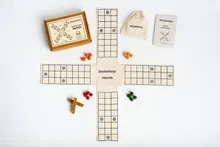
- 1Foldable cotton cloth board
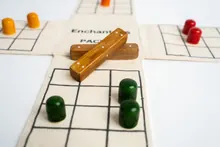
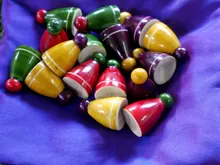
cross-shaped, 60 x 60 cm, for 2 or 4 players (Enchantoys' figures) - –Wooden pawns
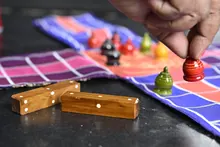
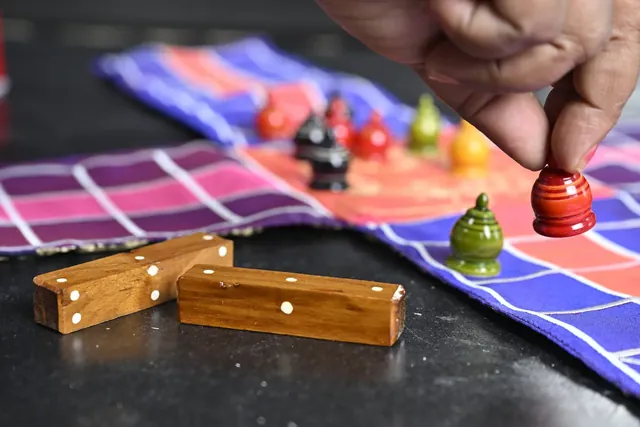
in four colours - –Long wooden dice
the four-sided dice of Chaupar - –Box and cloth bag
From Enchantoys' own photos of this cotton board and the contents on our Amazon.in link (traditional pawns and dice included). The photos show long wooden dice, the Chaupar way of throwing, and no cowrie shells: to throw cowries as described below, add six or seven of them.
Where to buy
Boardgames.in helps you choose a game. You place your order on Amazon.in, where you can check the seller, delivery estimate and return terms before paying. Amazon.in’s policies apply to your purchase. As an Amazon Associate, we may earn a commission when you buy through our links, at no extra cost to you.
How to pick a good setSize, pieces and the details worth checking.
Which set to buy
3 sets on Amazon.in, grouped by kind. Each button opens that set's own listing; check its size and pieces there before you buy.
Cotton cloth board1 set
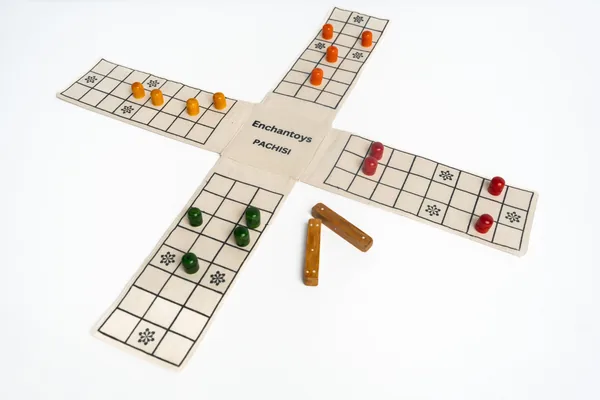
Enchantoys Pachisi Foldable Cotton Cloth Board
Enchantoys, Hyderabad
- Size
- Board 60 x 60 cm
- Build
- Foldable cotton cloth board, described by the maker as handcrafted
- In the box
- Foldable cotton cloth board, wooden pawns and long dice (the maker's photos and the listing)
- Ages
- 4 and up (the listing's figure)
Good for: Families who want a traditional cloth board that folds flat for trips, from a Hyderabad maker of handcrafted Indian games
Cloth board with dice2 sets

NAMSANTE Cloth Chaupar Pachisi with Dice and Tokens
NAMSANTE, Attibele (Bengaluru)
- Size
- Board size not given; about 250 g (the listing's figure)
- Build
- Foldable fabric board with wooden pieces (the listing's figures)
- In the box
- Fabric board, dice and tokens (the listing's figures)
- Ages
- 3 and up (the listing's figure)
Good for: Families who want a foldable cloth board that comes ready to play, with dice and tokens included
OrderIQ Chausar (Chopad) Cloth Set
OrderIQ
- Size
- Board size not given; about 460 g (the listing's figure)
- Build
- Cloth board with wooden pieces (the listing's figures)
- In the box
- Cloth Chausar board, wooden pieces and dice, for 2 or 4 players (the listing's figures)
Good for: Adults and families who want a fuller Chausar set, with wooden pieces and dice in one pack
What reviewers and players say
Pachisi is treated as the grand old game of Indian homes: makers call it one of the oldest and most played games in the country and sell it in cloth, silk and wood as a heritage gift. Families who know Ludo find more to think about here, with partners, bigger throws and safe castles, but a full game is long. The rules change from region to region, from six or seven cowries to long dice, and both makers and rules collections stress that there is no single correct version. Agreeing on the cowrie scores and house rules before the first throw avoids most arguments.
What people love
- Playing in teams with the partner opposite you, which Ludo doesn't have
- Cowrie shells and an embroidered cloth board that feel like a piece of family history
- More decisions than Ludo: which piece to move, when to shelter on a castle, when to split a big throw
- Plenty of regional rules and names to swap between families
Common complaints
- Long games: four players can take close to an hour or more
- Rules differ from family to family, from the cowrie scores to whether you must capture before going home
- Throws need agreeing on: how to toss the shells, and what to do with a shell that lands on its side
6 research sources
- Reference Pachisi (Wikipedia, read October 2026) · Wikipedia
- Reference The Rules of Pachisi & Chaupur (James Masters, Masters Traditional Games, 2025) · Masters Traditional Games
- Reference Pachisi (Ludii games database, Digital Ludeme Project, date not shown) · Ludii
- Reference How to play Pagade (Roll the Dice, date not shown) · Roll the Dice
- Reference Pachisi - foldable cotton cloth game (Enchantoys, August 2024) · Enchantoys
- Reference Chaupar (Wikipedia, read October 2026) · Wikipedia
Summarised in our own words from the sources above. We don't use Amazon reviews or ratings.
More like Pachisi (Chaupar)
Which game is the best fit?
Our picks if Pachisi (Chaupar) isn't quite right.
Swipe to compare every game
| Compare the games.The details that make a difference. |
YOU’RE VIEWING
 Pachisi (Chaupar) |
ANOTHER WAY TO PLAY
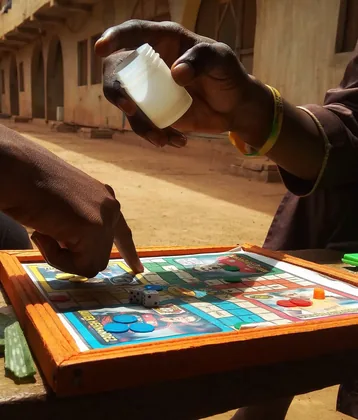 Ludo |
ANOTHER WAY TO PLAY
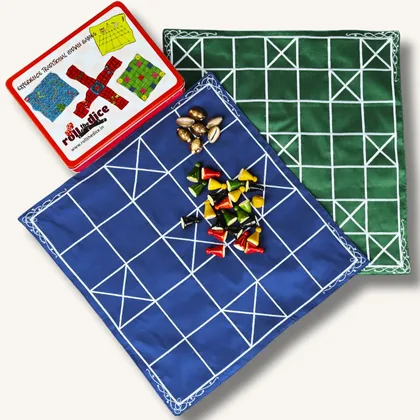 Chowka Bara (Ashta Chamma) |
ANOTHER WAY TO PLAY
 Trouble |
|---|---|---|---|---|
| Why consider it | This game The cross-shaped Indian race game that Ludo grew out of | A different fit Pachisi's simplified descendant: one die, a six to come out, every player for themselves | A different fit South India's square cousin, also thrown with cowrie shells, with a must-capture rule | A different fit A quick Ludo-style race for younger children, with the die sealed in a popping bubble |
| Players | 2–4 | 2–4 | 2–4 | 2–4 |
| Best with | 4 | 4 | 4 | 4 |
| Play time | 30–90 min | 30–60 min | 20–45 min | 30–60 min |
| Age | 6+ | 5+ | 5+ | 5+ |
| Rules | Medium | Easy | Easy | Easy |
| Indian edition | – | – | – | Imported |
| On this page | Explore Ludo | Explore Chowka Bara (Ashta Chamma) | Explore Trouble |
More from Enchantoys
Another way into their collection.
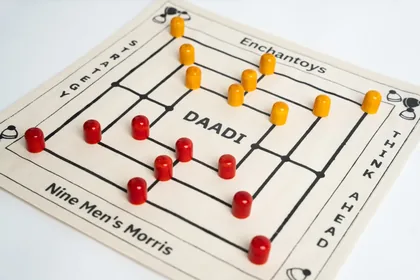
More roll-and-move games
Different games. A familiar kind of fun.
Business
India's own property game: buy cities, collect rent, build hotels
Ludo
India's favourite race game: roll a six, cut and race home
Snakes and Ladders
Climb the ladders, dodge the snakes, first to 100 wins

Monopoly Junior
Monopoly for little ones: one die, simple rules, half an hour
Trouble
Pop the bubble, race four pegs home and bump your rivals
Also playable with two
For game nights with two players.
Snakes and Ladders
Climb the ladders, dodge the snakes, first to 100 wins
Monopoly Junior
Monopoly for little ones: one die, simple rules, half an hour

Monopoly Junior: Peppa Pig Edition
Monopoly Junior with Pig family tokens and places from Peppa's world
Kabaddi
Raid, tag and tackle in a two-player board game of kabaddi
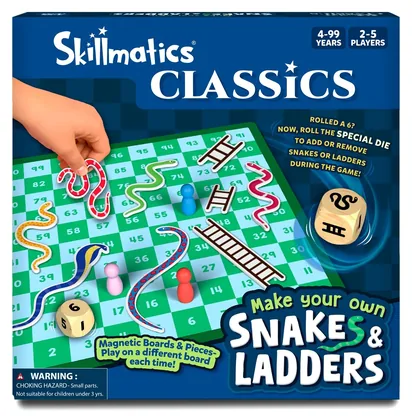
Magnetic Snakes & Ladders
Snakes and Ladders where you place the snakes and ladders yourself
Questions people ask about Pachisi (Chaupar)
Is Pachisi the same as Ludo?
No, but Ludo comes from it. Ludo is a simplified version patented in England in the late 19th century, played with one ordinary die and each player on their own. Pachisi uses cowrie shells with throws up to 25, a bigger board with safe castle squares, and is usually played two against two.
What is the difference between Pachisi and Chaupar?
They share the same cross-shaped board. Pachisi is thrown with cowrie shells, while Chaupar (Chausar, Chopat) traditionally uses long four-sided dice, and its rules change from region to region. Many families use the names for the same game, so agree on your rules before you start.
How do you count the cowrie shells in Pachisi?
With six shells, count the mouths facing up: two to five up move that many squares, six up is 6, one up is 10 and none up is 25. A 6, 10 or 25 gives you another throw and lets a piece come out of the centre. Seven-shell games have their own table.
Is Pachisi mentioned in the Mahabharata?
It is often said to be, because the epic's famous dice game was played on a board. Historians are cautious: Irving Finkel notes that the epic's descriptions don't match Pachisi. The game is clearly documented in Mughal times, when Akbar is said to have played on courtyards laid out as giant boards.
Is Pachisi the same as Thayam or Chowka Bara?
Not quite. The names overlap, and some makers use Thayam for Pachisi, but in South India Thaayam, Daayam, Chowka Bara and Ashta Chamma usually mean a square board of 5 x 5 or 7 x 7 houses played with four or six cowries. Pachisi is the cross-shaped board.
Game facts
- Publisher
- Enchantoys (Enchantoys LLP, Hyderabad)
- In India
- Enchantoys LLP (Hyderabad, Telangana)
- Players
- 2–4
- Language
- No reading – Nothing to read: you count cowrie shells and move pieces. The only thing to learn is what each throw scores, and that can be written on a slip of paper in any language.
Sources & photo creditsThe references behind this guide.
Facts on this page come from the publisher, the Indian maker or distributor, and the sources below. Photos are credited under each one.
- Enchantoys - Pachisi foldable cotton cloth game (maker's page)
- Enchantoys - Contact (Enchantoys LLP, Hyderabad)
- Enchantoys - Pachisi magnetic wooden board game (maker's page)
- Roll the Dice - Pagade traditional Pachisi set (maker's page)
- Roll the Dice - How to play Pagade (southern Karnataka rules)
- Masters Traditional Games - The Rules of Pachisi & Chaupur (James Masters)
- Ludii games database - Pachisi (rules recorded by G. Herklots, 1832)
- Ludii games database - Chaupar
- Pachisi - Wikipedia
- Chaupar - Wikipedia
- Fatehpur Sikri - Wikipedia (Pachisi Court)
- Ludo - Wikipedia
- Bureau of Indian Standards - Indian Standards on Toys: ensuring your child's safety (April 2023)