
Chowka Bara (Ashta Chamma)
South India's square race game, played with cowrie shells
- Set-up
- Under a minute
- Reading
- None
The quick verdict
Full verdict ↓Great for Grandparents teaching grandchildren the game they played on the floor as children
Think twice if You want a game with lots of choices: the cowrie throws decide much of it
How we rate it
Learning curve. Count the shells and move: young children pick it up quickly. The must-cut rule and the pairs are the only things to explain.
Luck & skill. The shells decide a lot, but choosing which pawn to move, when to chase a cut and when to sit on a safe house makes a real difference.
Interaction. Cutting is the heart of the game: you must cut an opponent before you can go home, and pairs block the way.
Set-up. Spread the board, pick colours and stack your four pawns on your home house. Agree the house rules (entry, pairs, three 4s or 8s in a row) before the first throw.
Reading. Nothing to read.
Learning curve: 1 = UNO or Connect 4; 3 = Catan; 5 = a heavy strategy game. These describe the experience, not an overall score.
Amazon Prime Get fast, free delivery on eligible items and early access to select sales. See Prime plans ↗
Is Chowka Bara (Ashta Chamma) right for you?
Great if
- Grandparents teaching grandchildren the game they played on the floor as children
- Families with young children: the 5-house board needs only counting up to four, plus the big throw of eight
- Two, three or four players, at home or on holiday, since a cloth board folds into a bag
- A heritage gift with handmade wooden pawns and real cowrie shells
Skip it if
- You want a game with lots of choices: the cowrie throws decide much of it
- You need fixed, printed rules: every region and many families play it a little differently
- There's a toddler at home who puts things in their mouth: cowrie shells and pawns are small
How Chowka Bara (Ashta Chamma) plays
Chowka Bara is played across South India and beyond under many names: Ashta Chamma in Telugu, Chowka Bara or Katte Mane in Kannada, Thaayam or Daayam in Tamil, Kavidi Kali or Pakidakali in Kerala, and others in Maharashtra, Gujarat and Madhya Pradesh. Families traditionally drew the board with chalk on the floor and threw split tamarind seeds or cowrie shells instead of dice. Its age is unknown: it is often called one of India's oldest games, but we found no solid source for that. A 2008 Telugu film, Ashta Chamma, is named after it.
- Time to teach: about 5 minutes.
- Reading and language: Nothing to read: you count the cowrie shells that land mouth up. The calls players shout during a game are in Kannada, Telugu or Tamil depending on the family, and any language works.
How to Play Chowka Bara (Ashta Chemma / Dayakattam / Ishto) | Ancient Indian Board Game Tutorial · Roll the Dice India · Official
Choose a video · Watch right here
If this creator doesn’t allow embedded playback, watch on YouTube ↗.
A turn, step by step
- 1Throw
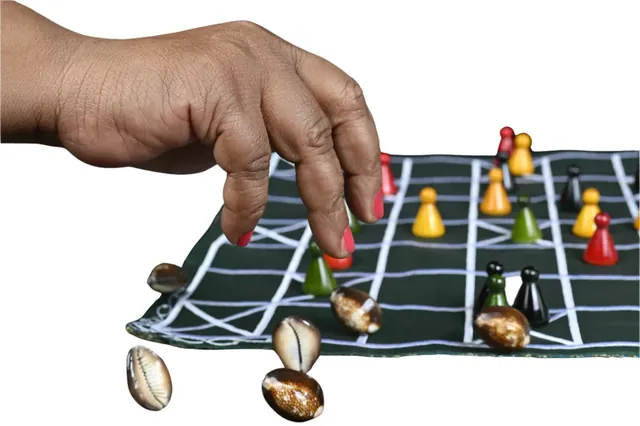
Throw four cowrie shells: one, two or three mouths up move that many; all four up is 4 and all four down is 8, and both earn another throw.
- 2Move
Move a pawn anticlockwise round the outer ring. You can share the throws of one turn between different pawns.
- 3Cut
Land on an opponent's pawn outside a crossed house to send it home. Until you have cut one, none of your pawns may enter the inner ring.
- 4Win
Work round the inner ring into the centre house. The first player with all four pawns in the centre wins.
The full explanation: how a game of Chowka Bara (Ashta Chamma) goes
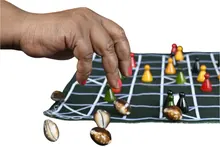
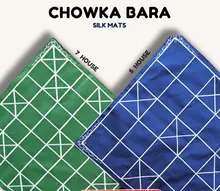
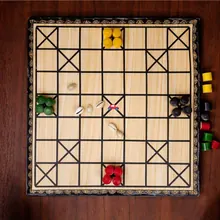
The board is a square of 5 x 5 houses (the bigger version has 7 x 7). Houses marked with a cross are safe: on a 5-house board these are the middle house of each side, one for each player, and the centre house, which is home. Each player has four pawns. In the southern Karnataka rules that Roll the Dice publishes, all four pawns start stacked on your own crossed house; in some homes a pawn can only come onto the board on a 4 or an 8.
Throw four cowrie shells and count the mouths facing up: one, two or three up move that many houses; all four up is chowka (4), and all four down is bara (8). In Telugu homes these are chamma (4) and ashta (8), which is where the name Ashta Chamma comes from. A 4 or 8 earns another throw, and you can share out the throws of one turn between different pawns. On the 7-house board you throw six shells, and in Roll the Dice's rules all six mouths up counts 6 and all six down 12, each with another throw.
Pawns move anticlockwise round the outer ring. Land on a house holding an opponent's pawn, unless it is a crossed house, and you cut it: it goes back to its home house to start again, and in many homes you get another throw. Here's the twist: none of your pawns may turn into the inner ring until you have cut at least one of an opponent's pawns. After that, your pawns turn in at the house to the left of your home and work round the inner ring to the centre. Two of your pawns on one house form a pair that is hard to pass or cut, and in most homes you need an exact throw to land in the centre. The first player with all four pawns home wins, and the others usually play on for second and third place.
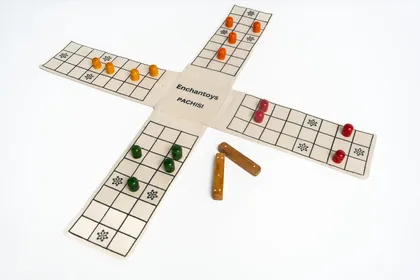
How is it different from Pachisi? Pachisi (Chaupar) is played on a cross-shaped board of three columns on each arm, with six or seven cowries and throws as big as 25, pieces starting in the centre, and usually two teams of two. Chowka Bara is a small square grid with four cowries and throws of 1 to 4 and 8, pawns starting on the edge, a must-cut-before-home rule and, usually, every player for themselves (partners sitting opposite may team up). A four-player game on the 5-house board takes about 20 to 40 minutes.
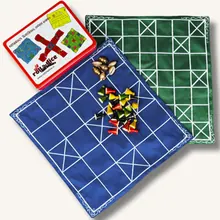
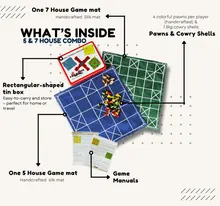
What's in the box
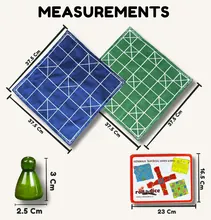
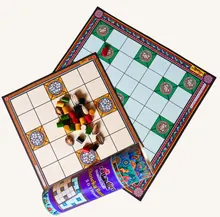
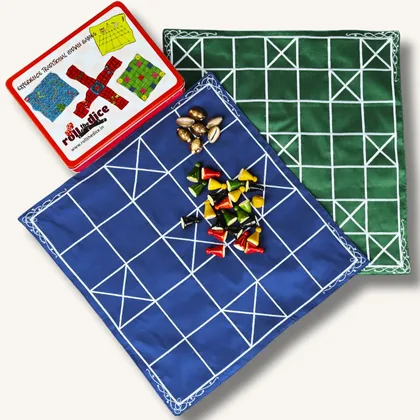
- 1Silk cloth board, 5 houses
about 12 x 12 inches (30 cm), maker's Heritage version - 1Silk cloth board, 7 houses
about 12 x 12 inches (30 cm), maker's Heritage version - 24Wooden pawns
six in each of four colours, about 2.5 cm tall, lacquered with vegetable dyes, made by Channapatna artisans (maker's statement) - 6Natural black cowrie shells
- 1Red tin box
From Roll the Dice's own what's-inside picture and page for its Heritage 5 and 7 Houses Combo, which match the silk mats and wooden pawns on our Amazon.in link. Roll the Dice also sells a Classic version with a cotton canvas mat and four pawns per player. Use four of the six cowries on the 5-house board and all six on the 7-house board. The rules are on the maker's website.
Where to buy
Boardgames.in helps you choose a game. You place your order on Amazon.in, where you can check the seller, delivery estimate and return terms before paying. Amazon.in’s policies apply to your purchase. As an Amazon Associate, we may earn a commission when you buy through our links, at no extra cost to you.
How to pick a good setSize, pieces and the details worth checking.
Which set to buy
4 sets on Amazon.in, grouped by kind. Each button opens that set's own listing; check its size and pieces there before you buy.
Cloth board3 sets
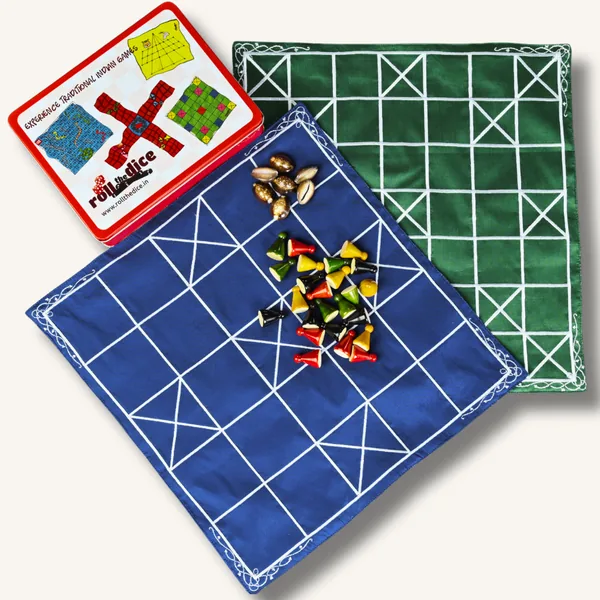
Roll the Dice Chowka Bara 5 and 7 Houses Combo
Roll the Dice (Trita Infotainment), Mysuru
- Size
- Silk mats about 12 x 12 inches (30 cm) each, in the maker's Heritage version
- Build
- Silk cloth boards with lacquered wooden pawns that the maker says are handcrafted by Channapatna artisans
- In the box
- 5-house and 7-house boards, 24 wooden pawns, 6 black cowrie shells and a tin box (maker's Heritage version)
- Ages
- 4 and up
Good for: Families who want both boards in one set: 5 houses for beginners and children, 7 houses for longer games
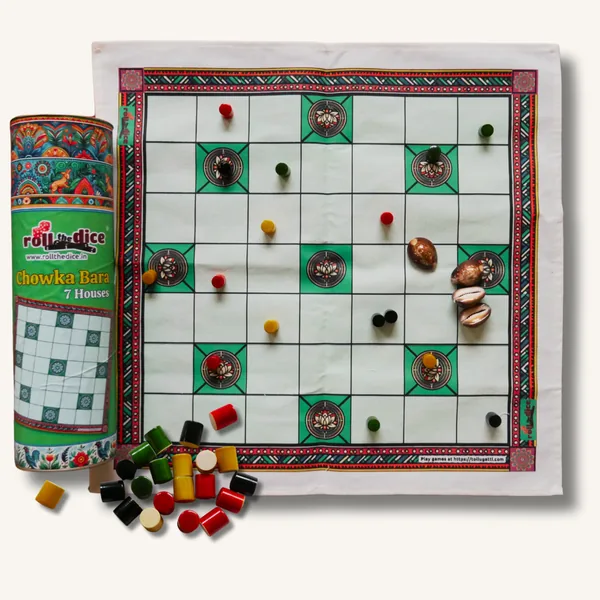
Roll the Dice Classic Chowka Bara, 7 Houses
Roll the Dice (Trita Infotainment), Mysuru
- Size
- Board size not given; about 200 g (the listing's figure)
- Build
- Fabric mat with a 7 x 7 board and wooden pawns that the maker says are made by Channapatna artisans
- In the box
- One 7-house mat and four pawns for each player (maker's page); cowries are not listed
- Ages
- 4 and up (the maker's figure)
Good for: Players who already know the game and want the bigger 7 x 7 board for a longer game
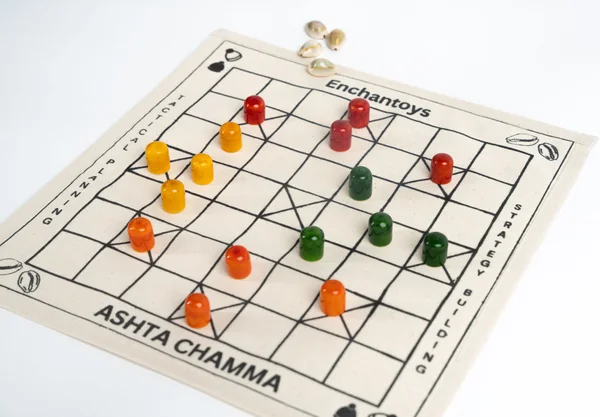
Enchantoys Ashta Chamma Cotton Fabric Board
Enchantoys, Hyderabad
- Size
- Not given for this set; Enchantoys' own fabric Ashta Chamma boards are 36 x 36 cm
- Build
- Cotton fabric board (the listing's figure)
- In the box
- Fabric Ashta Chamma board for 2 or 4 players; the listing gives no piece count
- Ages
- 4 and up (the listing's figure)
Good for: Families who want a light cloth board from a maker of handcrafted Indian games, easy to fold and carry
Wooden board1 set
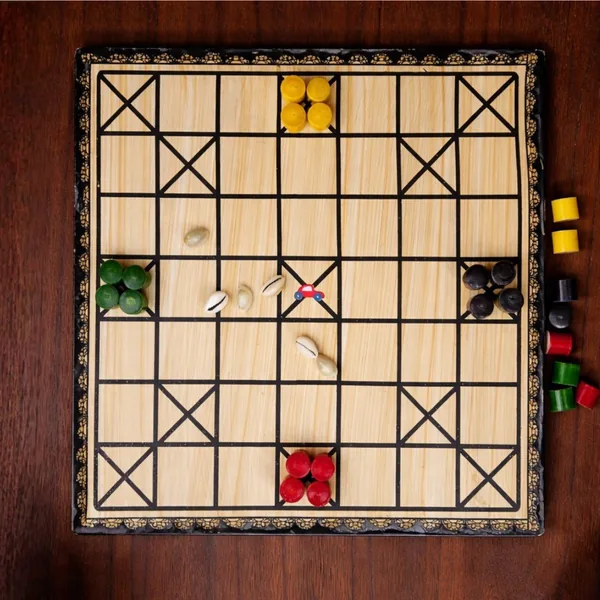
WETOYTOY Wooden Chowka Bara, Double-Sided 5 and 7 Houses
WETOYTOY (Namma Event), Bengaluru
- Size
- Board 30 x 30 x 1 cm (the maker's figure)
- Build
- Wooden board with 5 houses on one side and 7 on the other
- In the box
- Wooden board, cowrie shells, pawns and two cloth bags (the maker gives no counts)
- Ages
- 5 and up (the listing's figure)
Good for: Homes that want a board that lies flat and doesn't crease, with both the 5-house and 7-house games on one board
What reviewers and players say
Chowka Bara is remembered as the courtyard and verandah game of South Indian childhoods, played with tamarind seeds or cowries on a board chalked on the floor, and makers now sell it as a heritage set in cloth and wood. Its appeal is the speed of a cowrie throw and the must-cut rule, which turns a simple race into a chase. It is also a game of local rules: Roll the Dice publishes its southern Karnataka version, with table calls in Kannada, and the Wikipedia article lists different scores, entry rules and pairs from region to region. Families who agree their rules before the first throw avoid most arguments.
What people love
- Quick to learn: count the shells and move
- The must-cut rule, which makes everyone chase each other rather than just race
- Real cowrie shells and handmade wooden pawns that feel like part of family history
- Lively table calls and house rules handed down in each family
Common complaints
- Rules change from family to family, from entry throws to how pairs work
- Much of the game rests on the throw of the shells
- Small shells and pawns go missing and aren't safe around toddlers
5 research sources
- Reference Chowka bhara (Wikipedia, read October 2026) · Wikipedia
- Reference How to play Chowka Bara, 5 house (Roll the Dice, date not shown) · Roll the Dice
- Reference Learn Chowka Bara (TolluGatti, Roll the Dice, date not shown) · TolluGatti
- Reference KavidiKali, the Kerala version (DhaneW Software Research, 2010-2011) · KavidiKali
- Reference How to play Chowka Bara, 7 house (Roll the Dice, date not shown) · Roll the Dice
Summarised in our own words from the sources above. We don't use Amazon reviews or ratings.
More like Chowka Bara (Ashta Chamma)
Which game is the best fit?
Our picks if Chowka Bara (Ashta Chamma) isn't quite right.
Swipe to compare every game
| Compare the games.The details that make a difference. |
YOU’RE VIEWING
 Chowka Bara (Ashta Chamma) |
ANOTHER WAY TO PLAY
 Pachisi (Chaupar) |
ANOTHER WAY TO PLAY
 Ludo |
ANOTHER WAY TO PLAY
 Trouble |
|---|---|---|---|---|
| Why consider it | This game South India's square race game, played with cowrie shells | A different fit The cross-shaped cousin: more cowries, bigger throws and partners playing as teams | A different fit The race-home game every Indian family knows, with one die instead of shells | A different fit A quick race-and-capture game for younger children, with a popping dice bubble |
| Players | 2–4 | 2–4 | 2–4 | 2–4 |
| Best with | 4 | 4 | 4 | 4 |
| Play time | 20–45 min | 30–90 min | 30–60 min | 30–60 min |
| Age | 5+ | 6+ | 5+ | 5+ |
| Rules | Easy | Medium | Easy | Easy |
| Indian edition | – | – | – | Imported |
| On this page | Explore Pachisi (Chaupar) | Explore Ludo | Explore Trouble |
More from Roll the Dice
Another way into their collection.
More roll-and-move games
Different games. A familiar kind of fun.
Ludo
India's favourite race game: roll a six, cut and race home
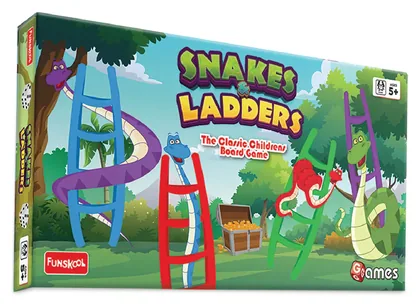
Snakes and Ladders
Climb the ladders, dodge the snakes, first to 100 wins

Monopoly Junior
Monopoly for little ones: one die, simple rules, half an hour
Trouble
Pop the bubble, race four pegs home and bump your rivals

Monopoly Junior: Peppa Pig Edition
Monopoly Junior with Pig family tokens and places from Peppa's world
Also playable with two
For game nights with two players.
Snakes and Ladders
Climb the ladders, dodge the snakes, first to 100 wins
Monopoly Junior
Monopoly for little ones: one die, simple rules, half an hour
Monopoly Junior: Peppa Pig Edition
Monopoly Junior with Pig family tokens and places from Peppa's world
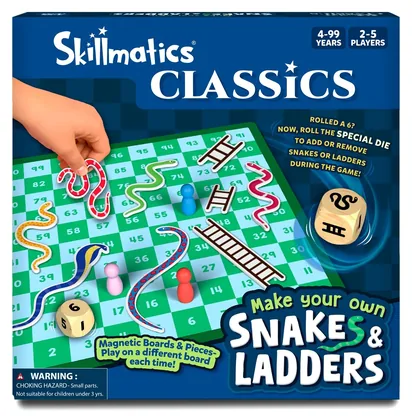
Magnetic Snakes & Ladders
Snakes and Ladders where you place the snakes and ladders yourself
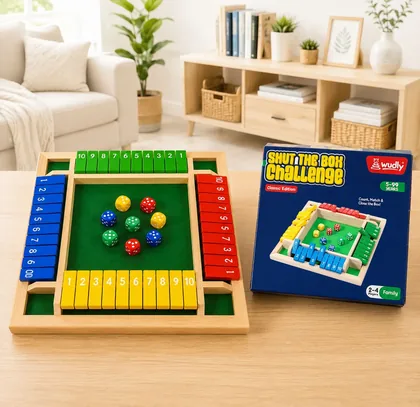
Shut the Box
Roll two dice, flip down the tiles, leave the smallest total
Questions people ask about Chowka Bara (Ashta Chamma)
Is Ashta Chamma the same as Chowka Bara?
Yes. Ashta Chamma is the Telugu name and Chowka Bara (or Katte Mane, Gatta Mane) the Kannada one; in Tamil Nadu it is Thaayam or Daayam, and in Kerala Kavidi Kali or Pakidakali. The board and the idea are the same, though throws and house rules vary a little from region to region.
How do you count cowrie shells in Chowka Bara?
With four shells, count the mouths facing up: one, two or three up move that many houses, all four up is 4 (chowka or chamma) and all four down is 8 (bara or ashta). A 4 or 8 gives you another throw. On a 7-house board you use six shells, with bigger top throws.
Do you have to cut a pawn before going home in Chowka Bara?
Yes, in almost every version. None of your pawns may turn into the inner squares until you have cut at least one of an opponent's pawns. Once you have, the rule is lifted for all your pawns, not just the one that made the cut.
What is the difference between Chowka Bara and Pachisi?
Chowka Bara is a square grid of 5 x 5 or 7 x 7 houses with four or six cowries, pawns starting on the edge and a must-cut rule before going home. Pachisi is a larger cross-shaped board with six or seven cowries, throws up to 25, pieces starting in the centre, and usually two teams of two.
Should I buy a 5-house or a 7-house board?
Start with 5 houses: it is the classic family game, quicker and easier for children. The 7-house board makes a longer game and needs six cowries. A combo set or a double-sided board lets you try both.
Game facts
- Publisher
- Roll the Dice (Trita Infotainment LLP, Mysuru)
- In India
- Trita Infotainment LLP (Roll the Dice, Mysuru, Karnataka)
- Players
- 2–4
- Language
- No reading – Nothing to read: you count the cowrie shells that land mouth up. The calls players shout during a game are in Kannada, Telugu or Tamil depending on the family, and any language works.
Sources & photo creditsThe references behind this guide.
Facts on this page come from the publisher, the Indian maker or distributor, and the sources below. Photos are credited under each one.
- Roll the Dice - Chowka Bara 5 and 7 Houses Combo (maker's page)
- Roll the Dice - How to play Chowka Bara (5 house)
- Roll the Dice - How to play Chowka Bara (7 house)
- Roll the Dice - Classic Chowka Bara 7 House (maker's page)
- Roll the Dice - Contact (Trita Infotainment LLP, Mysore)
- TolluGatti (Roll the Dice) - Learn Chowka Bara
- Chowka bhara - Wikipedia
- Enchantoys - Ashta Chamma handcrafted board game (maker's page)
- WETOYTOY - Wooden Chowka Bara double-sided 5 and 7 house board (maker's page)
- KavidiKali - the Kerala version of the game (DhaneW Software Research)
- Bureau of Indian Standards - Indian Standards on Toys: ensuring your child's safety (April 2023)