
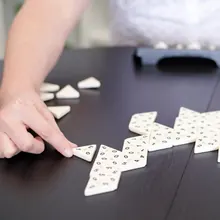
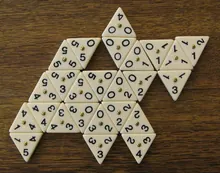
- Set-up
- About 2 min
- Reading
- None
The quick verdict
Full verdict ↓Great for Families who already play dominoes or rummy and want something familiar with a twist
Think twice if You want a game for more than four people: the box has four racks and the rules cover 2 to 4
How we rate it
Learning curve. Match the numbers, add up the tile, and watch for bonus shapes. Bridges take a game to spot, but the rules fit on one page. It sits with UNO and Connect 4 on our scale.
Luck & skill. Wikipedia's description says much depends on the luck of the draw, with skill playing a smaller part: choosing which tile to play, spotting bridges and hexagons, and leaving spaces you can fill.
Interaction. Everyone builds one shared layout, so a tile you place can open a hexagon for the next player or close off a space they needed. There is no direct attacking.
Set-up. Turn the tiles face down, mix them and deal nine each for two players or seven each for three or four onto the racks. Find paper and a pencil for the score.
Reading. Only numbers on the tiles; scoring needs simple adding.
Learning curve: 1 = UNO or Connect 4; 3 = Catan; 5 = a heavy strategy game. These describe the experience, not an overall score.
Is Triominos right for you?
Great if
- Families who already play dominoes or rummy and want something familiar with a twist
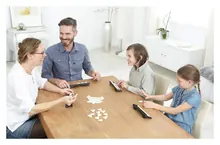
- Grandparents and children from 6 at the same table, since there is nothing to read
- Quiet adding practice for children: every tile you play is scored by adding its numbers
- Couples, because the rules give two players nine tiles each and it works well face to face
Skip it if
- You want a game for more than four people: the box has four racks and the rules cover 2 to 4
- Your group dislikes luck; the tiles you draw matter a lot
- Nobody wants to keep score on paper, since there is no score pad in the box
How Triominos plays
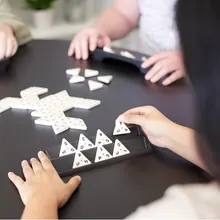
Set-up: turn all 56 tiles face down and mix them. With two players, each takes nine tiles onto a rack; with three or four, each takes seven. The rest stay face down as the spare pile. To choose who starts, everyone draws one spare tile and adds up its three numbers; the highest total goes first, and those tiles go back.
- Time to teach: about 5 minutes.
- Reading and language: The tiles carry only the numbers 0 to 5, so nobody needs to read during play, and one person can explain the rules in any language. Someone keeps score on paper, which needs simple adding. Funskool's rule sheet is in English.
How to Play Triominos in 2 minutes (Triominos rules) · Tabletop Duo
Choose a video · Watch right here
If this creator doesn’t allow embedded playback, watch on YouTube ↗.
A turn, step by step
- 1Match
Lay one tile next to the tiles on the table so the numbers on every touching edge match.
- 2Score
Add the tile's three numbers to your score, plus 40 for a bridge or 50 to 70 for closing hexagons.
- 3Draw
Can't play? Draw up to three tiles, losing 5 points for each, and 10 more if none fits.
- 4Win
Empty your rack first for 25 points plus everyone else's leftover tiles; the highest score wins.
The full explanation: how a game of Triominos goes
A turn: the first player lays any tile and scores its three numbers added together. After that, each player adds one tile next to the tiles on the table. Where two tiles touch, the numbers at both ends of the shared edge must match, and if your tile touches more than one tile, every corner must match. You score the total of the three numbers on the tile you played.
Bonuses make the big swings. A bridge, where one edge of your tile matches a tile on the table and its far point meets the corner of another tile across a gap, earns 40 extra points. Closing a ring of six tiles into a hexagon earns 50, two hexagons at once 60 and three at once 70.
If you can't play, or don't want to, draw a spare tile and try to place it, up to three times. Each draw costs 5 points, and if the third still doesn't fit you lose 10 more (25 in all) and your turn ends. If the spare pile is empty and you can't play, you simply miss your turn.
The round ends when someone plays their last tile: they score 25 bonus points plus the total left on everyone else's racks. If nobody can play, each player subtracts what is left on their own rack. Highest score wins, or, as Funskool's sheet suggests for a longer game, play rounds until someone passes 400 points and finish that round. Every tile is different, so keep an eye on what has been played and leave yourself spaces you can fill next turn.
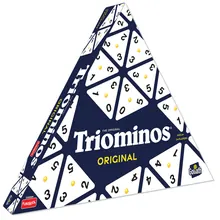
What's in the box
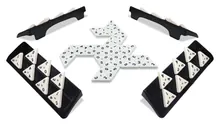
- 56Triomino tiles
triangular, with a number from 0 to 5 at each corner; every tile is different - 4Tile racks
one per player, to keep your tiles hidden - 1Instruction sheet
two pages, in English, including the 400-point tournament rule
Box: 0.26 kg. Handy to know for gifting and travel.
From Funskool's product page ('56 Triominos, 4 Racks, Instruction sheet') and its rule sheet for item 4935900 ('56 Triominos, 4 Racks'). The tile numbering (0 to 5, 56 unique combinations) is from Wikipedia's description of the standard set. There's no score pad, so you'll need paper and a pencil. One Indian store's description also mentions a storage pouch, which Funskool doesn't list.
Where to buy
How to make sure you get a genuine copyEditions and the details worth checking.
What reviewers and players say
Triominos has been around since 1965 because it takes a game everyone knows, dominoes, and adds two twists: three-sided tiles and bonus shapes worth big points. Pressman pitches it as friendly for all ages, mixing a little strategy with a lot of luck, and rules writers agree that the draw matters more than skill. The arguments players take to forums are about details, such as what counts as a bridge and what happens to tiles you draw but can't use, because rule sheets differ between editions. Read Funskool's sheet together before the first game and it plays smoothly.
What people love
- A familiar domino idea with a fresh twist, so it is easy to teach across ages
- Bridges and hexagons give exciting, high-scoring turns
- Quiet adding practice for children, since every tile is scored by adding its numbers
- Every tile is different, so paying attention to what has been played is rewarded
Common complaints
- The luck of the draw matters a lot, and skill plays a smaller part
- Rule sheets differ between editions on bridges, drawing and the opening tile, which can start arguments
- Rule versions that make you keep drawing until you can play drag on; Funskool's sheet already limits it to three draws
Based on 6 reviews and discussions
- Reference Triominoes (Wikipedia, read October 2026) · Wikipedia
- Reference Tri-Ominos Board Game: Rules for How to Play (Eric Mortensen, August 2025) · Geeky Hobbies
- Players Triominos Bridge Rules (December 2018) · Board & Card Games Stack Exchange
- Players Triominos 'take from the well' rules (September 2019) · Board & Card Games Stack Exchange
- Players What do you do with unused well tiles after your turn? (December 2020) · Board & Card Games Stack Exchange
- Reference Tri Ominos Instructional Video (Pressman, December 2016; description read, video not watched) · YouTube - pressmantoy
Summarised in our own words from the sources above. We don't use Amazon reviews or ratings.
More like Triominos
Which game is the best fit?
Our picks if Triominos isn't quite right.
Swipe to compare every game
| Compare the games.The details that make a difference. |
YOU’RE VIEWING
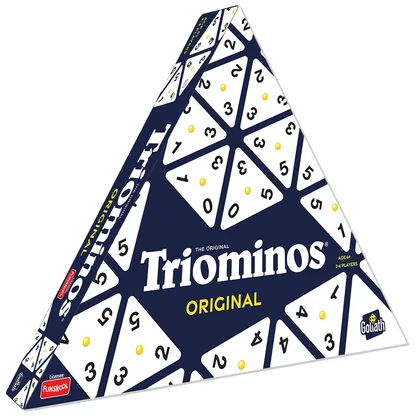 Triominos |
ANOTHER WAY TO PLAY
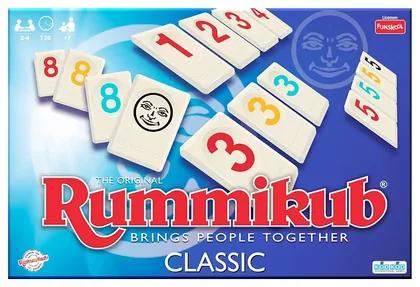 Rummikub |
ANOTHER WAY TO PLAY
 Qwirkle |
ANOTHER WAY TO PLAY
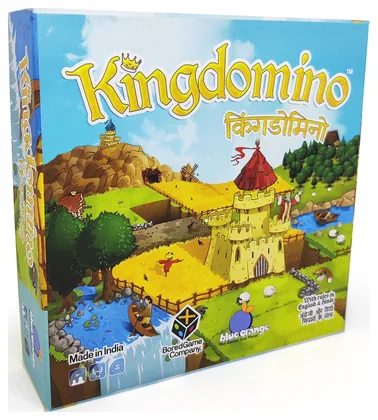 Kingdomino |
|---|---|---|---|---|
| Why consider it | This game Dominoes with three corners: match numbers, build hexagons, score big | A different fit Number tiles on racks again, for 2 to 4, with runs and groups instead of matching corners | A different fit Another tile-matching game where you score for every tile you lay and bonuses for completing lines | A different fit Domino-style tile laying with a picture theme, quick to teach to children |
| Players | 2–4 | 2–4 | 2–4 | 2–4 |
| Best with | 2-4 | 3-4 | 2-4 | 2 or 4 |
| Play time | 20–45 min | 20–60 min | 30–45 min | 15–25 min |
| Age | 6+ | 7+ | 6+ | 8+ |
| Rules | Easy | Easy | Easy | Easy |
| Indian edition | Available | Available | Imported | Available |
| On this page | Explore Rummikub | Explore Qwirkle | Explore Kingdomino |
More from Goliath
Another way into their collection.
Sequence
Play a card, claim its space, and make five in a row.
Flippin Out
Name it in ten seconds, flip the letter, outlast everyone
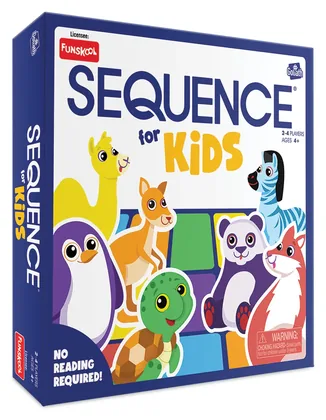
Sequence for Kids
Play animal cards, place chips and make four in a row
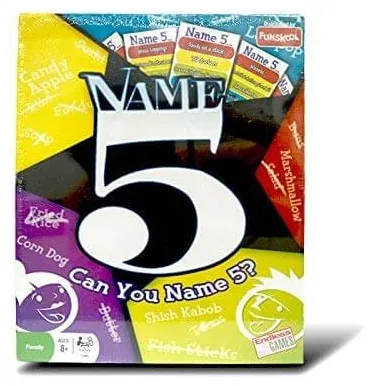
Name 5
Name five things before the sand runs out, then roll again
More from Funskool
Also made or sold in India by Funskool.
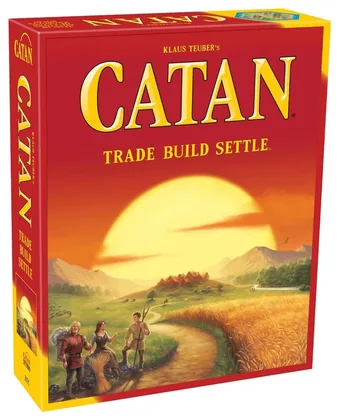
Catan
Trade wheat for brick, build roads, and race to ten points.
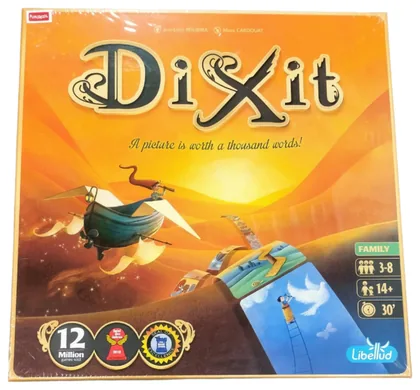
Dixit
Give a clue for a dreamlike picture, but not too obvious
Sequence
Play a card, claim its space, and make five in a row.
Rummikub
Rummy with tiles: build runs and groups, then rearrange the table
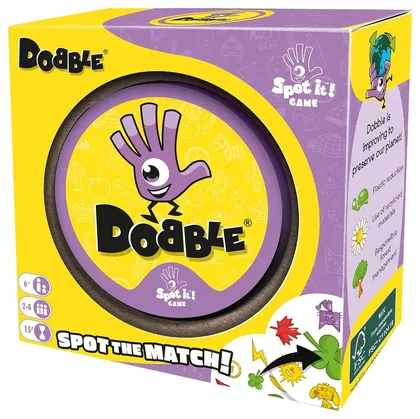
Dobble
Race to spot the one picture any two cards share
More tile-laying games
Different games. A familiar kind of fun.
Qwirkle
Match colours or shapes to build lines of six tiles
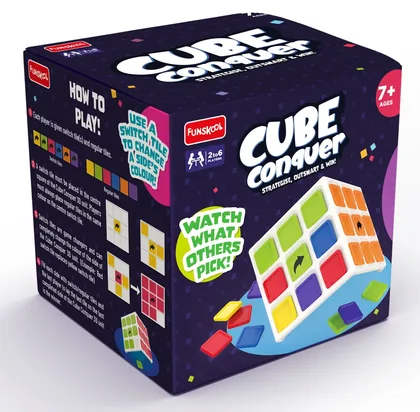
Cube Conquer
Match colour tiles on a 3D cube and lay the last one
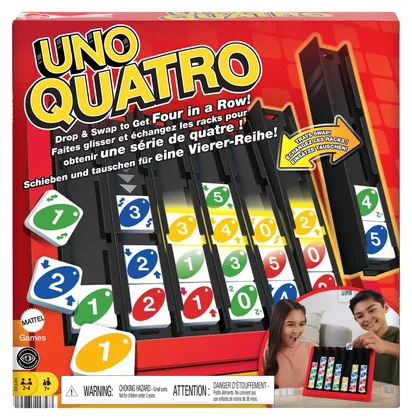
UNO Quatro
UNO meets four in a row: drop tiles, match colours or numbers
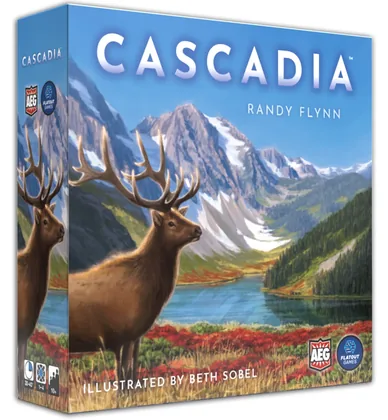
Cascadia
Build a Pacific Northwest landscape and fill it with wildlife

Connect 4 Card Game
Lay tiles, chase secret four-in-a-row missions, first to four wins
Questions people ask about Triominos
How is Triominos different from dominoes?
Dominoes are rectangles with two numbers; Triominos are triangles with a number at each corner, so you can build in more directions. Both numbers along a touching edge must match, and you score by adding up the tile you play. Bridges and hexagons add big bonuses that ordinary dominoes don't have.
How many tiles are in Triominos?
There are 56 tiles. Each corner shows a number from 0 to 5, and every tile has a different combination, from 0-0-0 up to 5-5-5. Funskool's box also has four racks to keep your tiles hidden.
What is a bridge and a hexagon in Triominos?
A hexagon is a ring of six tiles around one point; closing it earns 50 bonus points (60 for two at once, 70 for three). A bridge is a tile that matches along one edge while its opposite point meets another tile's corner across a gap, and it earns 40 bonus points. The bonus is added to the tile's own value.
Is Funskool Triominos the original game?
Yes. Funskool makes 'The Original Triominos' in India under licence from Goliath, which owns the game and the Pressman brand. The rule sheet in the box carries Goliath's copyright and the words 'Made in India'.
Can more than four people play Triominos?
Funskool's box and rule sheet are for 2 to 4 players, with four racks. Older Tri-Ominos rules allow five or six players with six tiles each, so a bigger group can try it, but extra players won't have racks.
Game facts
- Publisher
- Goliath (Pressman, now part of Goliath, sells it in the US as Tri-Ominos)
- In India
- Funskool (India) Ltd, Chennai, which makes it in India under licence from Goliath
- First published
- 1965
- Players
- 2–4
- Barcode
- 8901383493590
- Language
- No reading – The tiles carry only the numbers 0 to 5, so nobody needs to read during play, and one person can explain the rules in any language. Someone keeps score on paper, which needs simple adding. Funskool's rule sheet is in English.
- Box size and weight
- 0.26 kg
Sources & photo creditsThe references behind this guide.
Facts on this page come from the publisher, the Indian maker or distributor, and the sources below. Photos are credited under each one.