
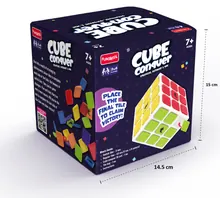
- Set-up
- About 2 min
- Reading
- None
The quick verdict
Full verdict ↓Great for Families with children from 7 who want a short strategy game rather than a race round a board
Think twice if You want a big board game with a long story; this is a compact tile game
How we rate it
Learning curve. The rules fit on one sheet, but the switch-tile swaps and the locking of sides take a round or two to click. Easier than Ticket to Ride, a little more to think about than UNO.
Luck & skill. You draw tiles blind from the bag, so luck decides what you hold; skill decides when to play a colour and when to hold back for the last tile.
Interaction. Players share one cube, can swap out each other's tiles with switch tiles, and race to control the final tile.
Set-up. Sort out the six switch tiles, deal the starting tiles and put the rest in the bag.
Reading. Only colours on the tiles; the rules are read once from the sheet.
Learning curve: 1 = UNO or Connect 4; 3 = Catan; 5 = a heavy strategy game. These describe the experience, not an overall score.
Is Cube Conquer right for you?
Great if
- Families with children from 7 who want a short strategy game rather than a race round a board
- Groups of up to six, such as cousins at a holiday get-together
- Players who like planning a move or two ahead and watching what others are holding
- Mixed-language groups, since the tiles carry only colours
Skip it if
- You want a big board game with a long story; this is a compact tile game
- Your group dislikes having its work undone, because switch tiles let others swap out your tiles
- You have toddlers at home who might put small tiles in their mouths
How Cube Conquer plays
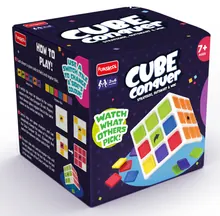
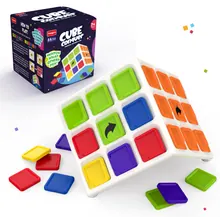
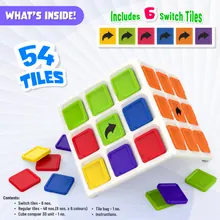
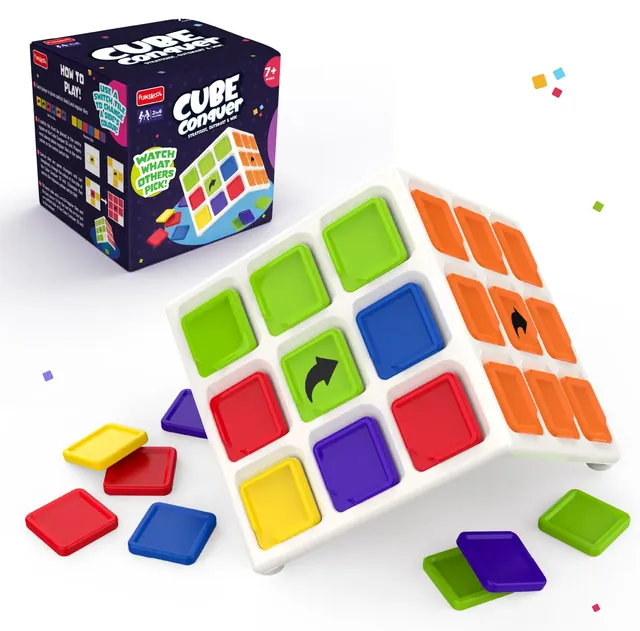
The Cube Conquer unit shows three sides of a cube, and each side is a grid of nine squares. There are 48 regular tiles, eight in each of six colours, and six switch tiles. With 2 or 3 players everyone gets two switch tiles; with 4 to 6 players everyone gets one. Each player also takes one regular tile of every colour, and the rest go into the tile bag.
- Time to teach: about 5 minutes.
- Reading and language: The tiles carry only colours, so nobody needs to read during play. The rules sheet is in English.
How to Play Cube Conquer | Fun & Easy Strategy Game for Kids & Families! · FUNSKOOL · Official
If this creator doesn’t allow embedded playback, watch on YouTube ↗.
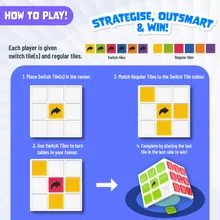
A turn, step by step
- 1Place
Put a switch tile in a side's centre square, or place any number of regular tiles of one colour on non-centre squares.
- 2Switch
On a side with a switch tile, only that colour may go there, and you may swap out non-matching tiles.
- 3Draw
Draw as many tiles from the bag as you placed; if you couldn't play, take one tile instead.
- 4Win
When two sides are locked, play moves to the last side; whoever lays the final tile there wins.
The full explanation: how a game of Cube Conquer goes
The youngest player starts and play goes clockwise. On your turn you either put a switch tile in the centre square of a side, or place regular tiles of one colour on any squares other than the centres; you may place as many tiles of that one colour as you like. Then you draw as many tiles from the bag as you placed. If you can't play, you miss the turn and take a tile from the bag.
Switch tiles are the twist. Once a side has a switch tile in its centre, only regular tiles of that colour can go on it, and you may swap out a tile of another colour, take it back into your hand and put a matching tile in its place. A switch tile can only be replaced by another switch tile; the old one goes back in the bag.
When two sides are each filled with tiles of a single colour, both are locked and play moves to the last side. On the last side, a replaced switch tile is taken out of the game instead of going back in the bag. Whoever lays the final tile on the last side wins.
Funskool's own tip: watch which tiles the others pick up, and hold on to tiles of one colour so that you control the chance to lay the last tile.
What's in the box
- 1Cube Conquer 3D unit
shows three sides of a cube, each a grid of nine squares - 48Regular tiles
8 in each of 6 colours - 6Switch tiles
one in each colour; they go only in a side's centre square - 1Tile bag
- 1Instruction sheet
in English, with a QR code for Funskool's how-to-play video
Box: 0.27 kg. Handy to know for gifting and travel.
From Funskool's product page and its 2025 instruction sheet ('Switch tiles - 6 nos., Regular tiles - 48 nos. (8 nos. x 6 colours), Cube conquer 3D unit - 1 no., Tile bag - 1 no.'). The sheet says the unit has three sides of nine squares each, so 27 squares are filled in a game, not six faces of a cube. Only one edition exists.
Where to buy
How to make sure you get a genuine copyEditions and the details worth checking.
What reviewers and players say
Cube Conquer is new, and no independent reviews or forum threads about it could be found, so this rests on Funskool's own sheet, video and launch news. Funskool pitches it as a quick strategy game for 2 to 6 players where switch tiles keep changing which colour each side needs. The rules are short and need no reading during play, which suits mixed-age family groups. The catch is the same as any take-that tile game: your careful work on a side can be swapped out by the next player.
What people love
- Plays with up to six, unusual for a small tile game
- No reading during play, so younger children and mixed-language groups can join
- Switch tiles keep the board changing until the last side
- Compact box that suits travel to relatives
Common complaints
- Tiles drawn blind from the bag mean luck plays a real part
- Players who dislike having their tiles swapped out may find it frustrating
- Small tiles: not for homes with toddlers
Based on 5 reviews and discussions
- Reference Cube Conquer (Funskool, read October 2026) · Funskool
- Reference Cube Conquer instruction sheet (Funskool, April 2025) · Funskool
- Reference How to Play Cube Conquer (FUNSKOOL, May 2025) · YouTube
- Reference Funskool launches exciting new toys and games to spark creativity this summer (Media Infoline, May 2025) · Media Infoline
- Reference Funskool Cube Conquer Games (store description, read October 2026) · Toycra
Summarised in our own words from the sources above. We don't use Amazon reviews or ratings.
More like Cube Conquer
Which game is the best fit?
Our picks if Cube Conquer isn't quite right.
Swipe to compare every game
| Compare the games.The details that make a difference. |
YOU’RE VIEWING
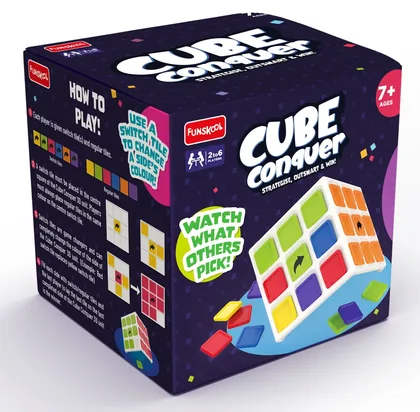 Cube Conquer |
ANOTHER WAY TO PLAY
 Qwirkle |
ANOTHER WAY TO PLAY
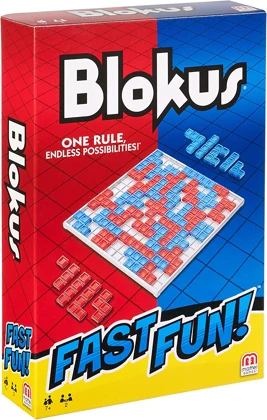 Blokus Fast Fun |
ANOTHER WAY TO PLAY
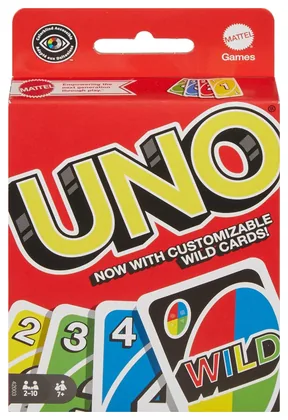 UNO |
|---|---|---|---|---|
| Why consider it | This game Match colour tiles on a 3D cube and lay the last one | A different fit Another colour-tile placing game, with shapes as well as colours and a scoring race | A different fit Coloured pieces, space on the board and blocking your rivals | A different fit Matching and switching colours in a quick card game for big groups |
| Players | 2–6 | 2–4 | 2 | 2–10 |
| Best with | 3-4 | 2-4 | 2 | 4-6 |
| Play time | 15–30 min | 30–45 min | 10–20 min | 10–30 min |
| Age | 7+ | 6+ | 7+ | 7+ |
| Rules | Easy | Easy | Easy | Easy |
| Indian edition | Available | Imported | Imported | Imported |
| On this page | Explore Qwirkle | Explore Blokus Fast Fun | Explore UNO |
More from Funskool
Another way into their collection.
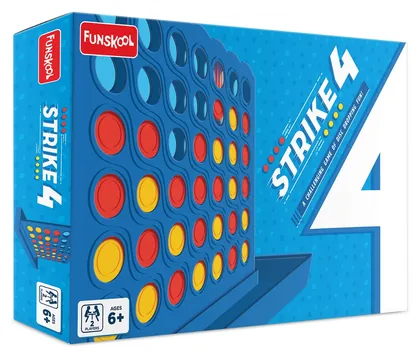
Strike 4
Drop discs, block your rival and line up four first
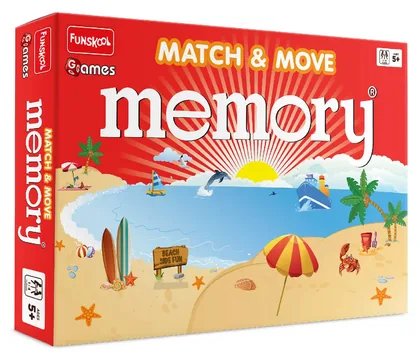
Match & Move Memory
Remember where each picture hides and race your piece home
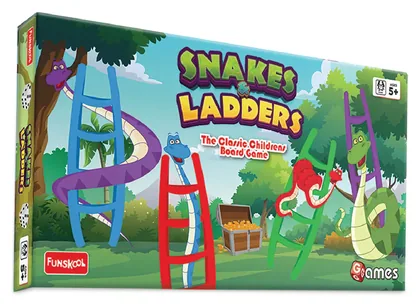
Snakes and Ladders
Climb the ladders, dodge the snakes, first to 100 wins
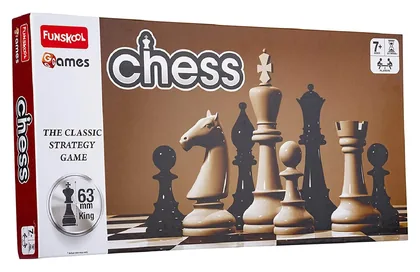
Chess
The two-player battle of wits that began in India as chaturanga
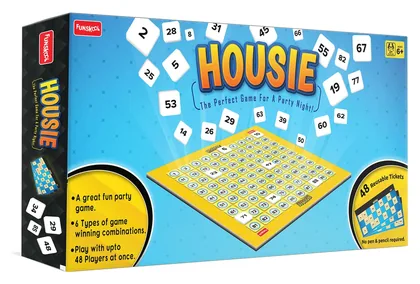
Housie (Tambola)
Strike off called numbers and shout first for lines and Full House
More pure strategy games
Different games. A familiar kind of fun.
Qwirkle
Match colours or shapes to build lines of six tiles
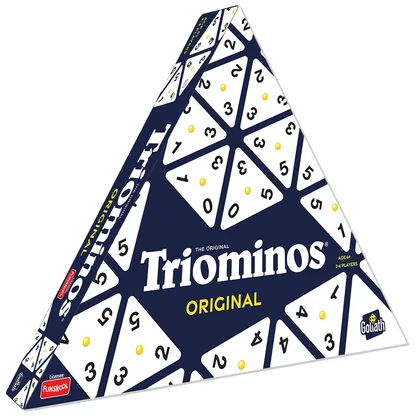
Triominos
Dominoes with three corners: match numbers, build hexagons, score big
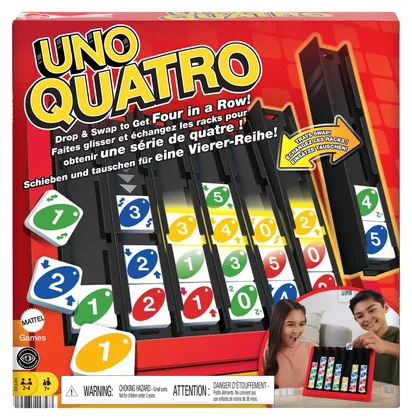
UNO Quatro
UNO meets four in a row: drop tiles, match colours or numbers
Blokus Fast Fun
A compact duel for two: fit your shapes, protect your corners, block your opponent
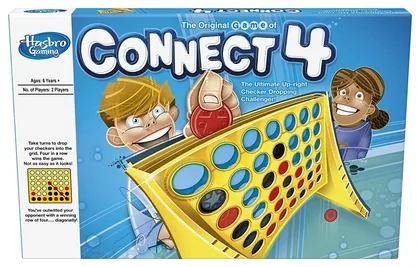
Connect 4
Drop discs, block your rival and get four in a row
Also playable with two
For game nights with two players.
Qwirkle
Match colours or shapes to build lines of six tiles
Triominos
Dominoes with three corners: match numbers, build hexagons, score big
UNO Quatro
UNO meets four in a row: drop tiles, match colours or numbers
Blokus Fast Fun
A compact duel for two: fit your shapes, protect your corners, block your opponent
Connect 4
Drop discs, block your rival and get four in a row
Questions people ask about Cube Conquer
How do you play Cube Conquer?
Players take turns placing colour tiles on the three sides of the Cube Conquer unit, then draw new tiles from the bag. Switch tiles in a side's centre decide which colour that side must take. Whoever lays the last tile on the last side wins.
How many players can play Cube Conquer?
Two to six. With 2 or 3 players each person starts with two switch tiles, and with 4 to 6 players each person starts with one, along with one regular tile of every colour.
What age is Cube Conquer for?
Funskool says 7 and up. There is nothing to read, so younger brothers and sisters can join a team with an adult, but the tiles are small, so keep them away from toddlers.
Is Cube Conquer made in India?
Yes. Funskool's own product page gives India as the country of origin, and Funskool is a Chennai toy company.
What are switch tiles in Cube Conquer?
They are the six special tiles that go only in the centre square of a side. A switch tile sets the colour for its side, lets players swap out tiles that don't match, and can itself be replaced only by another switch tile.
Game facts
- Publisher
- Funskool
- In India
- Funskool (India) Ltd, Chennai
- First published
- 2025
- Players
- 2–6
- Barcode
- 8901383493606
- Language
- No reading – The tiles carry only colours, so nobody needs to read during play. The rules sheet is in English.
- Box size and weight
- 0.27 kg
Sources & photo creditsThe references behind this guide.
Facts on this page come from the publisher, the Indian maker or distributor, and the sources below. Photos are credited under each one.