


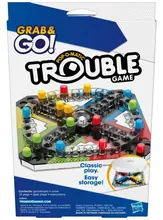
Family game
Trouble Grab and Go
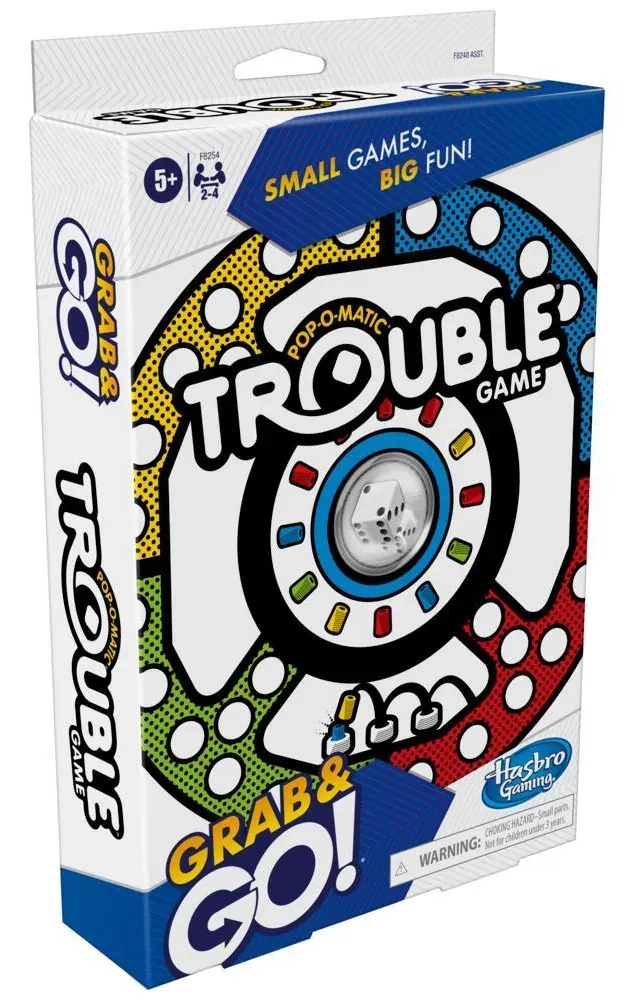
Pop the dome, race four pegs home, then close the lid
- Set-up
- Under a minute
- Reading
- None
The quick verdict
Full verdict ↓Great for Children from 5 on train journeys, flights and holidays, since the die is sealed in its dome and can't roll away
Think twice if You want a game that adults will enjoy on their own: it is almost all luck
How we rate it
Learning curve. Pop, count and move. Children who know Ludo already know most of it, which puts it with UNO and Connect 4 at 1 on our scale.
Luck & skill. Almost all luck: the die decides nearly everything. The only choices are which peg to move and whether to chase a rival.
Interaction. There is no trading or talking, but landing on a rival sends their peg home, and a 1 helps everyone except the player who rolled it.
Set-up. The first time, an adult sticks the four labels on. After that, take the cover off, put four pegs of each colour in Home and start popping, all in under a minute.
Reading. No text during play; you read the number on the die and count spaces.
Learning curve: 1 = UNO or Connect 4; 3 = Catan; 5 = a heavy strategy game. These describe the experience, not an overall score.
Is Trouble Grab and Go right for you?
Great if
- Children from 5 on train journeys, flights and holidays, since the die is sealed in its dome and can't roll away
- Families who play Ludo and want a quicker, poppier cousin that packs into a bag
- Two to four cousins at a get-together, with a two-player option that gives each child two colours
- A small gift for a young child who loves pressing buttons
Skip it if
- You want a game that adults will enjoy on their own: it is almost all luck
- You want the full-size board's Double Trouble and Warp spaces, which the travel rules leave out
- There are toddlers at home: the pegs are small parts, not for children under 3
How Trouble Grab and Go plays
Set-up: the first time, an adult takes the cover off the gameboard and sticks on the four labels from the label sheet, lining up the colours. For each game, every player takes the four pegs of one colour and puts them in their matching Home spaces. The youngest player goes first, and play moves to the left.
- Time to teach: about 5 minutes.
- Reading and language: Nothing to read during play: you press the dome, read the number on the die and count spaces. Once someone has explained the rules, children can play it in Hindi, Kannada or any mix of languages; only the small rules leaflet is in English.
How to play Trouble (2016 rules - warp space) · Triple S Games
Choose a video · Watch right here
If this creator doesn’t allow embedded playback, watch on YouTube ↗.
A turn, step by step
- 1Pop
Press the Pop-O-Matic dome. A 6 brings a peg out or moves one six spaces and gives you one more pop; a 1 lets everyone else bring a peg out.
- 2Move
Move one peg clockwise by the number. Land on a rival and send it back Home; you can't land on your own peg.
- 3Finish
After one lap, move into the nearest open Finish space, with no exact count needed. First to get all four pegs into Finish wins.
The full explanation: how a game of Trouble Grab and Go goes
A turn: press the Pop-O-Matic dome and move by the number on the die. A 6 lets you either move a peg from Home to your Start space or move a peg on the track six spaces, and then pop again, but you only get one extra move a turn. A 2, 3, 4 or 5 moves any one of your pegs already on the track. A 1 means you can't move at all, but every other player gets to bring a peg from Home to Start.
Bumping and blocking: land on a rival's peg and it goes back to its Home, so it needs another 6 or someone else's 1 to come out. You can't land on your own peg; if that is your only move, you miss the turn. And you can't bring a new peg out while one of yours is still sitting on your Start space.
Winning: each peg goes once round the track and then into your Finish zone. You don't need an exact count: move into the first open Finish space nearest the dome. The first player with all four pegs in Finish wins. With only two players, the rules let each of you play with two colours. To pack up, put the pegs in their Finish zones and put the cover back on.
How it differs from our full-size Trouble page: the box on that page (Hasbro's item A5064) has a bigger square board on four rubber feet, and its rules add optional Double Trouble and Warp spaces. The travel box has the same Pop-O-Matic, the same rules for 1s and 6s and the same 16 pegs, on a smaller all-in-one board with a cover that keeps the pegs in, and its leaflet has no Double Trouble or Warp spaces.
What's in the box
- 1Gameboard
an all-in-one travel board with the Pop-O-Matic die roller built in; the pegs store in their Finish zones - 1Cover
fits over the gameboard to keep the pegs in when you pack up - 16Pegs
four in each of four colours - 1Label sheet
four labels an adult sticks on the first time, lining up the colours - 1Instructions
Box: 25.2 × 15.7 × 4.7 cm, 0.15 kg. Handy to know for gifting and travel.
From the contents printed on Hasbro's photo of the F8254 box back, its 2023 leaflet and Hasbro's instructions page, for the box our link goes to. The full-size Trouble on our Trouble page (Hasbro's item A5064) has a separate plastic game unit on a bigger board, 16 pegs and 4 rubber feet, but no cover.
Where to buy
How to make sure you get a genuine copyEditions and the details worth checking.
What reviewers and players say
We found no written reviews or forum threads about the 2023 travel box, so this summary leans on Hasbro's own description and rules, and on the classic game it shrinks. Hasbro pitches it as the same Pop-O-Matic Trouble in a smaller size, for road trips, train and plane journeys and holidays, with the pegs stored in their Finish zones under a cover. Hasbro launched its Grab and Go range in India in 2019 with a TV advert of a family on a train, and Trouble was part of it. For Indian families it is a pocket cousin of Ludo with a die that can't get lost; the trade-offs are tiny pegs, no Warp or Double Trouble spaces and a game that is almost all luck.
What people love
- The sealed Pop-O-Matic dome: no dice rolling off a train table or under a seat
- The cover closes over the pegs in their Finish zones, so the game packs away in seconds
- Very quick to learn for anyone who already knows Ludo
- A two-player option that gives each child two colours
Common complaints
- Almost entirely luck, so adults soon lose interest
- Small pegs are easy to lose if the cover isn't put back on
- The popping is loud in a quiet train compartment or waiting room
Based on 4 reviews and discussions
- Reference Trouble Grab and Go, instructions and 2023 leaflet (Hasbro, item F8254) · Hasbro
- Reference Trouble Grab and Go Game, product record (Hasbro Consumer Care, F8254) · Hasbro
- Reference Hasbro launches 'Grab and Go' range in India with new TVC (exchange4media, November 2019) · exchange4media
- Reference Trouble (board game) · Wikipedia
Summarised in our own words from the sources above. We don't use Amazon reviews or ratings.
More like Trouble Grab and Go
Which game is the best fit?
Our picks if Trouble Grab and Go isn't quite right.
Swipe to compare every game
| Compare the games.The details that make a difference. |
YOU’RE VIEWING
 Trouble Grab and Go
|
ANOTHER WAY TO PLAY
 Trouble
|
ANOTHER WAY TO PLAY
 Ludo
Ludo
|
ANOTHER WAY TO PLAY
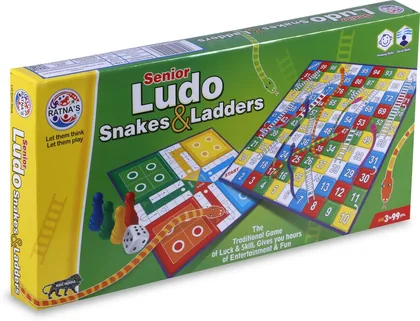 Snakes and Ladders
|
|---|---|---|---|---|
| Why consider it | This game Pop the dome, race four pegs home, then close the lid | A different fit The full-size game: a bigger board with optional Double Trouble and Warp spaces | A different fit The Indian family race game Trouble grew from: four counters, a six to start, and cutting rivals | A different fit An even simpler dice race for children from 4, with no choices to make |
| Players | 2–4 | 2–4 | 2–4 | 2–4 |
| Best with | 4 | 4 | 4 | 2-4 |
| Play time | 20–40 min | 30–60 min | 30–60 min | 15–30 min |
| Age | 5+ | 5+ | 5+ | 4+ |
| Rules | Easy | Easy | Easy | Easy |
| Indian edition | Available | Imported | Available | Available |
| On this page | Explore Trouble | Explore Ludo | Explore Snakes and Ladders |
More by Frank Kohner
Another way into their collection.
More from Hasbro
Another way into their collection.
Monopoly
Roll, buy property, collect rent, and bankrupt everyone else
Scrabble
Build crossword words from letter tiles and chase the bonus squares

Jenga
Pull a block, stack it on top, don't topple the tower

Taboo
Get your team to guess the word without saying the obvious ones
Monopoly Deal
Monopoly as a 15-minute card game of rent, raids and sets
More roll-and-move games
Different games. A familiar kind of fun.
Ludo
India's favourite race game: roll a six, cut and race home
Snakes and Ladders
Climb the ladders, dodge the snakes, first to 100 wins

Monopoly Junior
Monopoly for little ones: one die, simple rules, half an hour
Trouble
Pop the bubble, race four pegs home and bump your rivals

Monopoly Junior: Peppa Pig Edition
Monopoly Junior with Pig family tokens and places from Peppa's world
Also playable with two
For game nights with two players.
Snakes and Ladders
Climb the ladders, dodge the snakes, first to 100 wins
Monopoly Junior
Monopoly for little ones: one die, simple rules, half an hour
Monopoly Junior: Peppa Pig Edition
Monopoly Junior with Pig family tokens and places from Peppa's world
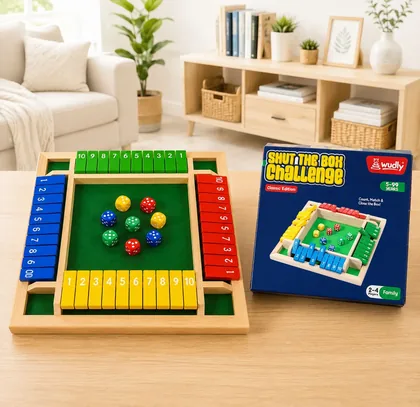
Shut the Box
Roll two dice, flip down the tiles, leave the smallest total
Match & Move Memory
Remember where each picture hides and race your piece home
Questions people ask about Trouble Grab and Go
What is the difference between Trouble and Trouble Grab and Go?
Grab and Go is Hasbro's travel version, with the same Pop-O-Matic dome, 16 pegs and rules for 1s and 6s on a smaller all-in-one board. A cover closes over the pegs for travel, and its rules leave out the full-size game's optional Double Trouble and Warp spaces.
Can two people play Trouble Grab and Go?
Yes. It is for 2 to 4 players, and Hasbro's travel leaflet suggests that in a two-player game each of you can play with two sets of coloured pegs, which makes the race longer and gives more chances to bump each other.
What happens when you roll a 1 in Trouble Grab and Go?
You can't move, but every other player may move a peg from Home to Start. A 6 is the other way to bring a peg out, and it also gives you another pop.
Do you need an exact roll to finish in Trouble Grab and Go?
No. Once a peg has gone round the track, you move it into the first open Finish space closest to the dome. The first player with all four pegs in Finish wins.
Is Trouble Grab and Go like Ludo?
Very like it. Both race four pieces from home round the board, need a six to start and send a rival back when you land on it; Trouble comes from Ludo, which itself comes from India's Pachisi. Trouble differs in its popping dice dome, its rule for a 1 and having no safe squares on the track.
Game facts
- Designed by
- Frank Kohner, Paul Kohner, Fred Kroll
- Publisher
- Hasbro (Hasbro Gaming)
- In India
- Hasbro India Toys, Mumbai (named as importer and manufacturer on the Amazon.in listing)
- First published
- 2023
- Players
- 2–4
- Barcode
- 195166231013
- Language
- No reading – Nothing to read during play: you press the dome, read the number on the die and count spaces. Once someone has explained the rules, children can play it in Hindi, Kannada or any mix of languages; only the small rules leaflet is in English.
- Box size and weight
- 25.2 × 15.7 × 4.7 cm, 0.15 kg
Sources & photo creditsThe references behind this guide.
Facts on this page come from the publisher, the Indian maker or distributor, and the sources below. Photos are credited under each one.
- Hasbro - Trouble Grab and Go, instructions page (item F8254)
- Hasbro - Trouble Grab and Go rules leaflet, F8254 (PDF, 2023)
- Hasbro Consumer Care (US) - Trouble Grab and Go Game, product record (F8254)
- Hasbro India - Pop-O-Matic Trouble Grab & Go Game, instructions page (older item B1003)
- Toycra - Hasbro Trouble Grab and Go Game (F8254)
- exchange4media - Hasbro launches 'Grab and Go' range in India with new TVC (November 2019)
- Wikipedia - Trouble (board game)