
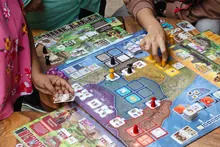
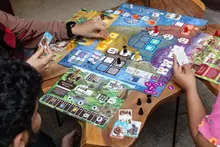
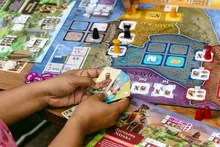
- Set-up
- About 15 min
- Reading
- Some
The quick verdict
Full verdict ↓Great for Teenagers and adults who have enjoyed Catan or Bharata 600 BC and want a meatier planning game
Think twice if You want a light game for the whole family after dinner; a game takes 60 to 90 minutes and needs a careful teach
How we rate it
Learning curve. A medium-to-heavy worker-placement game, closer to Wingspan than to Catan on our scale. A turn is only 'place a pawn and take the reward', but there are four resources, three kinds of artisan, several tile types, events and kingdom powers to juggle. The designer calls it at most medium; the Italian reviewer found it heavier than it looks.
Luck & skill. There are no dice and no hidden hands to speak of; the main luck is the order in which merchant and event tiles come into the market. The Italian reviewer praises the near-absence of blind luck, so planning and timing decide most games.
Interaction. No attacks: you get in each other's way by taking spaces first in the borderlands and empire, racing for events, and copying a rival's action with a diplomat if you have more culture.
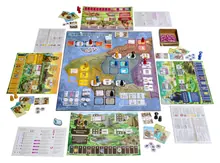
Set-up. Lay out the map, give each player a kingdom board and wooden pawns, and sort the many tile and card types, artisans, merchants, events, temples and sections, into their places. Meeple University's teach spends about three minutes on set-up alone, so allow 15 minutes, more for the first game. This is our estimate.
Reading. The rulebook is long and in English, and player aids, development cards and some tiles carry short rules text. Once learned, play needs little reading.
Learning curve: 1 = UNO or Connect 4; 3 = Catan; 5 = a heavy strategy game. These describe the experience, not an overall score.
Is Nayakas right for you?
Great if
- Teenagers and adults who have enjoyed Catan or Bharata 600 BC and want a meatier planning game
- History lovers curious about the south after Vijayanagara: Madurai, Thanjavur, Keladi and Mysore each have their own kingdom
- Groups who prefer building to fighting: there are no armies, attacks or dice
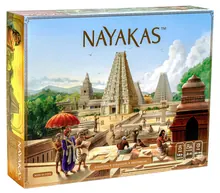
- A gift that looks good on the table, with a gold-foil box, a big map of southern India and hand-made Channapatna wooden pawns
Skip it if
- You want a light game for the whole family after dinner; a game takes 60 to 90 minutes and needs a careful teach
- Your group gets restless when players stop to think; every placement matters and turns can slow down
- Your children are under 14 and new to strategy games; Bharata 600 BC's Basic game is an easier start
How Nayakas plays
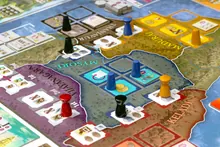
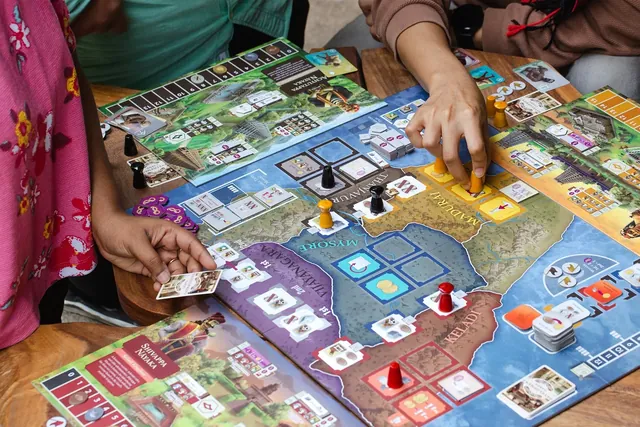
Each player rules one of four southern kingdoms that grew out of the Vijayanagara Empire: Keladi, Madurai, Mysore or Thanjavur. Each kingdom has its own player board and its own home spaces on the big map of southern India, so each seat plays a little differently. Between the kingdoms are shared borderland spaces, and in the middle are stronger empire spaces that usually cost culture to use.
- Time to teach: about 20 minutes.
- Reading and language: The rulebook, player aids and cards are in English, and some cards and tiles carry short rules text, so at least one player should be comfortable teaching from English rules. Teaching videos exist in English; no Hindi edition or Hindi rules were found.
How to play NAYAKAS - Indian Board game//Chai & Games · Chai & Games
Choose a video · Watch right here
If this creator doesn’t allow embedded playback, watch on YouTube ↗.
A turn, step by step
- 1Place
Put one labourer or diplomat on an empty space and take its reward at once: materials, gold, culture, artisans or a tile.
- 2Build
Once all pawns are out, each player may finish one section of a temple, water tank or fort by paying materials and artisans.
- 3Reset
Pawns come home, unused artisans leave, the market refills and events pay prosperity to whoever placed the most flags.
- 4Win
After nine rounds, or sooner once enough monuments are built, the most prosperity points wins; ties go to culture.
The full explanation: how a game of Nayakas goes
A round has three parts. First, going round the table, each player places one wooden pawn at a time on an empty space and takes its reward at once: stone, clay, gold or culture, artisans (architects, masons and sculptors), or merchant and event tiles from the trading post. Labourers can only work at home and in your own borderlands. Diplomats go further, paying culture outside your colour, and a player with more culture can even copy a rival's action on a shared space.
Then everyone builds. In turn order, each player may complete one section of one of their monuments, a temple, a water tank or a fort, by paying materials and the right artisans. A finished section gives you a tile that is either a lasting ability or a point of prosperity. Temples score at the end and open new home spaces, while forts and water systems give useful facility tiles. At the end of the round pawns come home, artisans you didn't use leave, the market refills and events are settled, with prosperity going to whoever placed the most flags on them.
The game lasts up to nine rounds and can end sooner once enough monuments have been finished. The player with the most prosperity points wins, counting prosperity tokens, temples, some face-down section tiles, unused development cards and end-game goals; a tie goes to the player with more culture. Compared with Bharata 600 BC, from the same Bengaluru maker, there are no armies, battles or dice: you compete for spaces, artisans and events, and planning and timing decide the winner.
A note on history: in 1565 an alliance of Deccan sultanates defeated Vijayanagara's army in the battle usually called Talikota, and the capital at Hampi was sacked. The empire carried on in a smaller form, but over the following decades its southern governors, the Nayakas of places such as Madurai, Thanjavur and Keladi, ruled more and more like independent kings, and the Wodeyar rulers of Mysore broke away too. The game keeps that starting point and leaves out the wars, turning the period into a contest of building temples, water tanks and forts, the kind of building these rulers are remembered for.
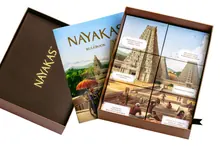
What's in the box
- 1Game board
map of medieval southern India - 1Rulebook
English - 4Player boards
one for each kingdom - 4Player aid cards
- 16Resource tokens
- 12Artisan cards
- 12Development cards
- 12Labourer pawns
artisanal wood - 8Diplomat pawns
artisanal wood - 1Building tracker
artisanal wood - 1Conch
first-player marker - 16Merchant tiles
- 12Temple tiles
- 6Event tiles
- 38Section tiles
- 12Facility tiles
- 7Borderland tiles
- 20Event tokens
- 25Prosperity tokens
Box: 1.9 kg. Handy to know for gifting and travel.
From the components list printed on the back of the box (read by Claude on the maker's photo); its first four items match the listing behind our Amazon.in link. The maker says the wooden pawns and markers are hand-made in Channapatna and coloured with natural dyes. There is only one edition.
Where to buy
How to make sure you get a genuine copyEditions and the details worth checking.
What reviewers and players say
Nayakas is new (2025), and coverage is still thin. The fullest review we read, a long Italian one written with a copy from the publisher, praises its tight, nearly luck-free planning, the four kingdoms that each play differently and the Channapatna wooden pieces. It also warns that the game is heavier than it looks and can slow down while players work out the best move. Teaching videos from India's Chai & Games and Australia's Meeple University cover the rules, so learning it is easier than the rulebook's length suggests.
What people love
- Very little luck: no dice, and planning and timing decide the game
- Four kingdoms with their own powers, so each seat plays a little differently
- The production: a big map of southern India, a gold-foil cover and hand-made Channapatna wooden pawns
- A setting rarely seen in games: the temples, water tanks and forts of the south after Vijayanagara
Common complaints
- Heavier than it looks, and players who think hard over each placement can slow the game down
- Artisans you hire but don't use leave at the end of the round, which can feel harsh
- It takes a couple of games to see how the different parts fit together
4 research sources
- Review Nayakas [Recensione]: rules, opinions and interview (Gianluca di Picardia, July 2026, in Italian) · Giochi sul Nostro Tavolo
- Reference How to play NAYAKAS - Indian Board game (October 2025) · Chai & Games (YouTube)
- Reference Nayakas - How to Play. Complete, Clear, Concise Board Game Tutorial (April 2026) · Meeple University (YouTube)
- Reference NAYAKAS (Board Game) (publisher's game page, read October 2026) · GoIndia Games
Summarised in our own words from the sources above. We don't use Amazon reviews or ratings.
More like Nayakas
Which game is the best fit?
Our picks if Nayakas isn't quite right.
Swipe to compare every game
| Compare the games.The details that make a difference. |
YOU’RE VIEWING
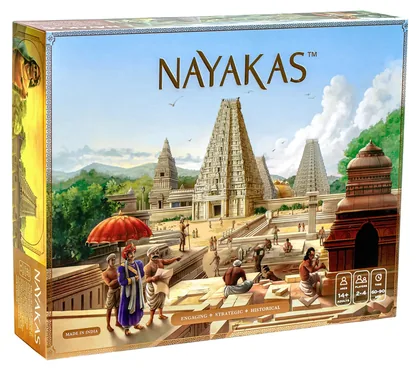 Nayakas |
ANOTHER WAY TO PLAY
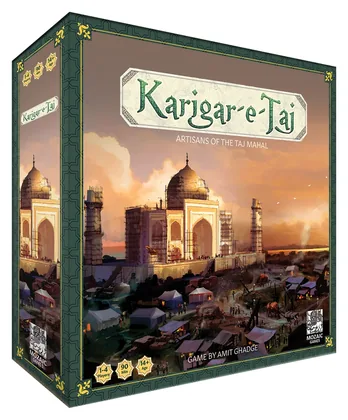 Karigar-e-Taj |
ANOTHER WAY TO PLAY
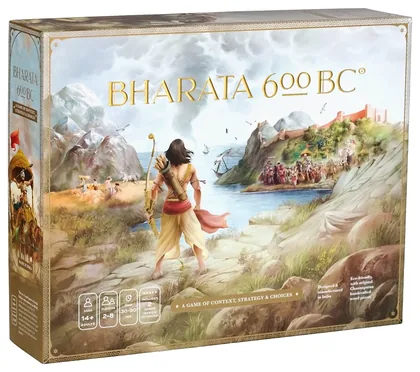 Bharata 600 BC |
ANOTHER WAY TO PLAY
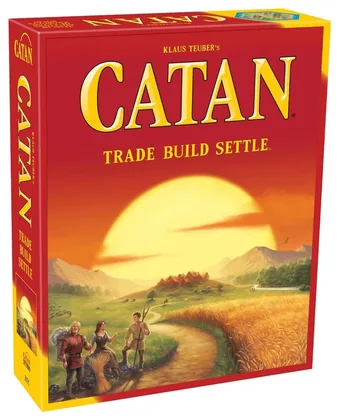 Catan |
|---|---|---|---|---|
| Why consider it | This game Rule a Nayaka kingdom and build temples, water tanks and forts | A different fit Another Indian worker-placement game about artisans building a great monument, the Taj Mahal, a little lighter | A different fit Same maker and look, but kingdoms raise armies and battle over the map instead of building | A different fit Gather materials and build to score; Catan uses dice and trading where Nayakas uses worker placement |
| Players | 2–4 | 1–4 | 2–4 | 3–4 |
| Best with | 3-4 | 3-4 | 3-4 | 4 |
| Play time | 60–90 min | 60–90 min | 30–90 min | 60–90 min |
| Age | 14+ | 14+ | 14+ | 10+ |
| Rules | Involved | Medium | Medium | Medium |
| Indian edition | Available | Available | Available | Available |
| On this page | Explore Karigar-e-Taj | Explore Bharata 600 BC | Explore Catan |
More from GoIndia Games
Another way into their collection.
More engine-building games
Different games. A familiar kind of fun.
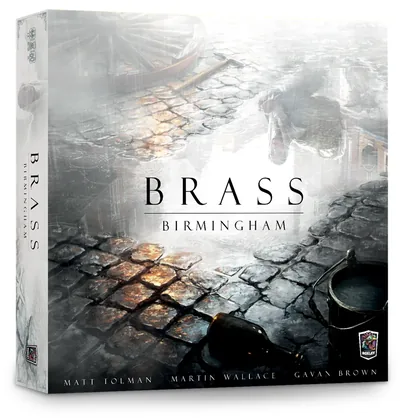
Brass: Birmingham
Build canals, railways and industries across Industrial Revolution England

Terraforming Mars
Race rival corporations to make Mars warm, wet and breathable
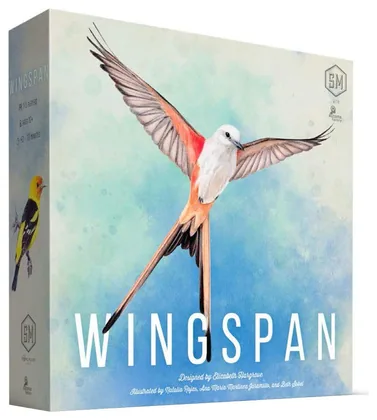
Wingspan
Calm card game about birds where every new bird boosts your turns.

7 Wonders
Build an ancient city by picking one card and passing the rest.
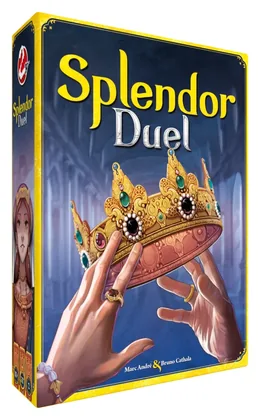
Splendor Duel
Splendor rebuilt for two: gem lines, card powers, three ways to win
Also playable with two
For game nights with two players.
Brass: Birmingham
Build canals, railways and industries across Industrial Revolution England
Wingspan
Calm card game about birds where every new bird boosts your turns.
Splendor Duel
Splendor rebuilt for two: gem lines, card powers, three ways to win

7 Wonders Duel
The 7 Wonders civilisation race, rebuilt as a tense 30-minute duel
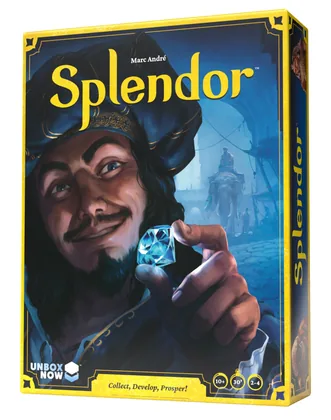
Splendor
A quick gem-trading race where every card makes the next easier.
Questions people ask about Nayakas
Is Nayakas made in India?
Yes. GoIndia Games, a Bengaluru company, describes Nayakas as 100% made in India, with wooden pieces hand-made by Channapatna craftspeople and coloured with natural dyes. The box back names its company, Terrals Entertainment Pvt. Ltd. of Bengaluru, as publisher and manufacturer.
How is Nayakas different from Bharata 600 BC?
Both come from GoIndia Games and share the gold-foil box and Channapatna wood, but they play very differently. Bharata 600 BC is about raising armies and taking regions with card battles, while Nayakas is a worker-placement game with no fighting: you compete for spaces, artisans and events to build temples, water tanks and forts. Nayakas is the longer and more demanding of the two.
What age is Nayakas suitable for?
The box says 14 and up, for 2 to 4 players and 60 to 90 minutes. If you see an online listing that says 14 months, it is a typo. Younger teenagers who already enjoy strategy games can manage it once someone has learned the rules well.
Can two people play Nayakas?
Yes, the box says 2 to 4 players. We couldn't check the printed rules for any changes at two players, so the 3 to 4 we suggest as the best count is our own estimate, based on how much the game depends on competing for shared spaces and events.
Is Nayakas hard to learn?
It is a step up from Catan. Turns are simple, place a pawn and take its reward, but there are several kinds of resources, artisans, tiles and events to keep track of. Allow about 20 minutes to teach and expect the first game to run long; the teaching videos from Chai & Games and Meeple University help.
Game facts
- Designed by
- Andy Desa
- Publisher
- GoIndia Games (Terrals Entertainment Pvt. Ltd., Bengaluru)
- In India
- GoIndia Games (the publisher itself)
- First published
- 2025
- Players
- 2–4
- Barcode
- 0726436434805
- Language
- Some English – The rulebook, player aids and cards are in English, and some cards and tiles carry short rules text, so at least one player should be comfortable teaching from English rules. Teaching videos exist in English; no Hindi edition or Hindi rules were found.
- Box size and weight
- 1.9 kg
Sources & photo creditsThe references behind this guide.
Facts on this page come from the publisher, the Indian maker or distributor, and the sources below. Photos are credited under each one.
- GoIndia Games - NAYAKAS (Board Game) product page and photos
- GoIndia Games - About (100% made in India)
- GoIndia Games - Terms of service (company details)
- Giochi sul Nostro Tavolo - Nayakas review, rules and interview (in Italian, July 2026)
- Chai & Games - How to play NAYAKAS (YouTube, October 2025)
- Meeple University - Nayakas: How to Play (YouTube, April 2026)