


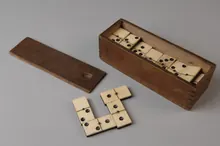
- Set-up
- Under a minute
- Reading
- None
The quick verdict
Full verdict ↓Great for Children of about 6 to 10 practising counting and matching: every move is a hunt for the right number of dots
Think twice if You want a game with no luck: the tiles you are dealt decide a lot
How we rate it
Learning curve. Match the numbers end to end. The scoring games (Muggins) add sums but no new rules to speak of.
Luck & skill. The deal matters a lot, but choosing which end to play on, keeping a number your opponents lack and blocking at the right moment all count.
Interaction. Everyone plays on the same line, so each tile you lay changes what the next player can do; in the block game you can deliberately leave numbers others don't hold.
Set-up. Turn the tiles face down, shuffle and deal; it takes under a minute.
Reading. Only dots on the tiles.
Learning curve: 1 = UNO or Connect 4; 3 = Catan; 5 = a heavy strategy game. These describe the experience, not an overall score.
Amazon Prime Get fast, free delivery on eligible items and early access to select sales. See Prime plans ↗
Is Dominoes right for you?
Great if
- Children of about 6 to 10 practising counting and matching: every move is a hunt for the right number of dots
- Grandparents and grandchildren at one table: the rules are the same for everyone and the deal evens things out
- Train journeys and holidays: 28 tiles pack into a small box or pouch
- Adults who enjoy quick sums: Muggins scores every time the two ends add up to a multiple of five
Skip it if
- You want a game with no luck: the tiles you are dealt decide a lot
- There is a child under about 3 at home: the tiles are small parts
- You were after toppling domino runs: those are building sets with many more blocks, and this page is about the tile game
How Dominoes plays
Dominoes began in China: the oldest written mentions come from the Song dynasty, around the 1100s and 1200s, and the traditional Chinese set had 32 tiles based on the throws of two dice, with no blanks. The European game, with blanks and 28 tiles, appeared in France in the mid-1700s (the word 'domino' is first recorded in 1762), spread to Italy, Austria, Germany and Britain, and reached England by the late 1700s. The double-six set from that European line is the one sold across India today, in plastic with black or coloured dots, or in wood.
- Time to teach: about 5 minutes.
- Reading and language: Nothing to read: the tiles carry dots from 0 to 6. Children need to recognise or count up to six dots, and the scoring games add some mental arithmetic.
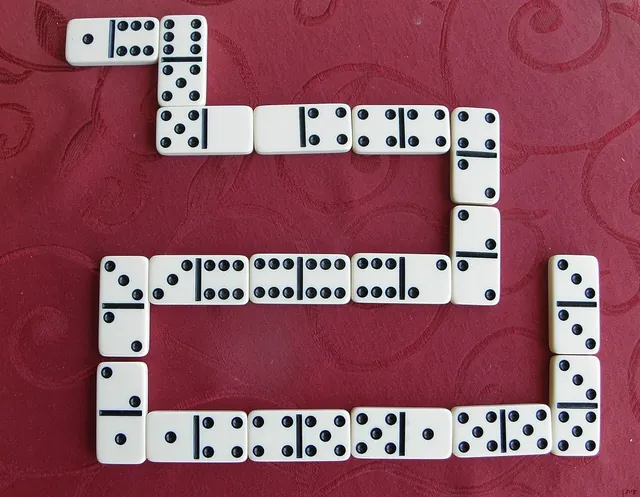
How to Play Dominoes · Triple S Games
Choose a video · Watch right here
If this creator doesn’t allow embedded playback, watch on YouTube ↗.
A turn, step by step
- 1Deal
Shuffle the 28 tiles face down. With two players take 7 each; with three or four, 5 each (or as your rules say).
- 2Match
On your turn, add one tile to either open end of the line so the touching halves show the same number of dots.
- 3Stuck
Can't match? In the block game you pass; in the draw game you take from the boneyard until you can play.
- 4Win
First to play every tile wins the hand. If the line is blocked, the lowest total of dots in hand wins.
The full explanation: how a game of Dominoes goes
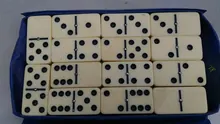
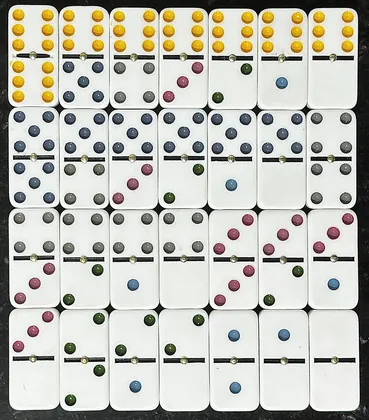
A double-six set has one tile for every pairing of the numbers 0 (blank) to 6: 28 tiles, including seven doubles from double-blank to double-six. Turn them face down and shuffle. With two players, each takes 7 tiles. With three or four, each takes 5 in the block game (in the draw game, 7 each for three players and 6 each for four). The tiles left over stay face down at the side; this pile is called the boneyard. Stand your tiles on edge so nobody else can see them.
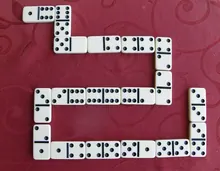
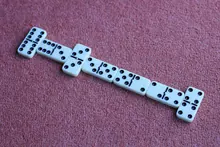
The first player lays any tile; some families let whoever holds the highest double start. Then, in turn, each player adds one tile to either open end of the line, matching numbers: a 6 against a 6, a blank against a blank. Doubles are laid crosswise. In the block game, if you cannot match either end, you pass. In the draw game you take tiles from the boneyard until you can play, but the last two always stay there; once only two are left, you pass. An Indian store's listing for the Ratna's set gives the simplest version: seven tiles each, match the dots, and play until the line is blocked or someone runs out of tiles.
The hand ends as soon as someone plays their last tile, or when nobody can play (a blocked game). Everyone then counts the dots left in their hand; the lowest total wins the hand and scores the others' totals minus their own. Play hands until someone reaches 100 points with two players, or 61 with three or four. With young children, skip the scoring: whoever goes out first, or holds the fewest dots when the line is blocked, wins.
Once the basic game is easy, try Muggins (also called All Fives): whenever the two open ends add up to 5, 10, 15 or 20 after your tile, you score that many points, and the first to 250 (two players) or 200 (three or four) wins, which makes it good practice for the five times table. Fives and Threes scores multiples of both five and three. Mexican Train, played with a bigger double-twelve set of 91 tiles, gives every player a line of their own. There is no single Indian rulebook, so agree before you start: block or draw, who goes first, and the target score.
What's in the box
- 28Plastic domino tiles
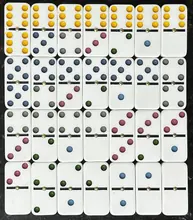
double-six set of colourful printed plastic tiles with dice-style dots from 0 to 6
Box: 26 × 21 × 4 cm, 0.4 kg. Handy to know for gifting and travel.
From the listing our Amazon.in link goes to: 28 colourful printed plastic tiles with dice-style dots from 0 to 6. No rules leaflet is mentioned. The box is about 26 x 21 x 4 cm (the listing's figure).
Where to buy
Boardgames.in helps you choose a game. You place your order on Amazon.in, where you can check the seller, delivery estimate and return terms before paying. Amazon.in’s policies apply to your purchase. As an Amazon Associate, we may earn a commission when you buy through our links, at no extra cost to you.
How to pick a good setSize, pieces and the details worth checking.
Which set to buy
3 sets on Amazon.in, grouped by kind. Each button opens that set's own listing; check its size and pieces there before you buy.
Plastic, boxed2 sets

Ratna's Double 6 Dominoes
Ratna's (Prem Ratna Toys), Mumbai
- Size
- Box 26 x 21 x 4 cm (the listing's figure)
- Build
- Plastic tiles with dots from 0 to 6 in colours
- In the box
- 28 double-six tiles in a box
Good for: Families who want a complete boxed set for 2 to 4 players, with coloured dots that help children match

Toy Imagine Double Six Colour Dot Dominoes
Toy Imagine
- Size
- Not given; about 400 g with its box (the listing's figure)
- Build
- Plastic tiles with coloured dots
- In the box
- 28 double-six tiles in a box
Good for: Players who want a second boxed plastic set with coloured dots for the games shelf
Plastic, travel pouch1 set

PLUSPOINT Double-Six Dominoes with Pouch
PLUSPOINT
- Size
- Not given; the set weighs about 380 g (the listing's figure)
- Build
- Plastic tiles in several colours
- In the box
- 28 double-six tiles in a pouch
Good for: Travel and holidays: a full 28-tile set that packs into a soft pouch
What reviewers and players say
Dominoes is valued as a simple, sociable classic that works for children and grandparents alike: the rules take minutes to learn, and the scoring games turn it into quick mental arithmetic. Rules writers point out that it is not pure luck, because setting a number you hold plenty of and keeping control of the ends wins hands, especially in partnership play; in one online discussion a player remembered a grandfather who beat everyone and called it deceptively hard to play well. Players there also talk fondly of heavy, clicky tiles, so a solid set adds to the fun. The block game can stall when nobody can play, which the draw game avoids by letting players take from the boneyard, and because rules differ so much between places it pays to agree on one version before the first tile goes down.
What people love
- Learned in a few minutes by anyone who can count to six
- Many games from one set: block, draw, Muggins, Fives and Threes and more
- Muggins and All Fives turn every move into a quick sum
- A good heavy set feels and sounds satisfying, and lasts for decades
Common complaints
- A poor deal can decide a hand, especially in the two-player block game
- Rules differ from place to place, so agree on one version before you start
- Block games can stall when nobody can play; the draw game avoids that
6 research sources
- Reference Block Dominoes (Joe Celko and John McLeod, updated December 2025) · pagat.com
- Reference Draw Dominoes (Joe Celko and John McLeod, updated December 2025) · pagat.com
- Reference Muggins (Joe Celko and John McLeod, updated March 2023) · pagat.com
- Reference Domino Games (John McLeod, updated August 2026) · pagat.com
- Reference Dominoes (Wikipedia, read October 2026) · Wikipedia
- Players Question About Dominoes (r/boardgames, October 2024) · Reddit
Summarised in our own words from the sources above. We don't use Amazon reviews or ratings.
More like Dominoes
Which game is the best fit?
Our picks if Dominoes isn't quite right.
Swipe to compare every game
| Compare the games.The details that make a difference. |
YOU’RE VIEWING
 Dominoes |
ANOTHER WAY TO PLAY
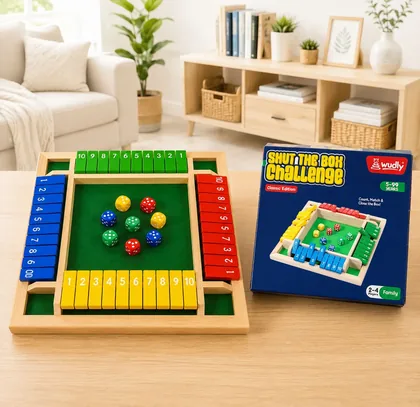 Shut the Box |
ANOTHER WAY TO PLAY
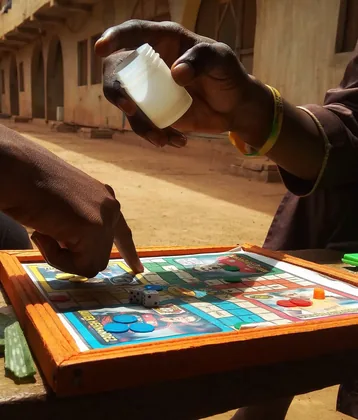 Ludo |
ANOTHER WAY TO PLAY
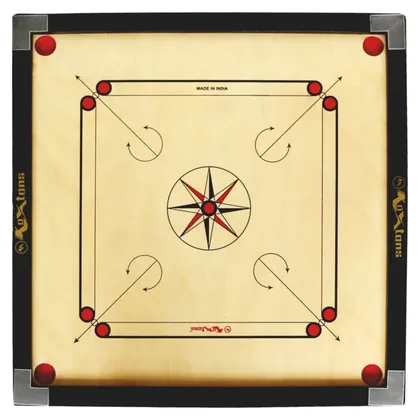 Carrom |
|---|---|---|---|---|
| Why consider it | This game Match the dots end to end and empty your hand first | A different fit Another quick game of dots and numbers, with dice and flip-down tiles | A different fit India's favourite family table game for 2 to 4 | A different fit Another family-table classic, all about skill |
| Players | 2–4 | 1–4 | 2–4 | 2–4 |
| Best with | 2-4 | 2-4 | 4 | 2 or 4 |
| Play time | 10–30 min | 5–20 min | 30–60 min | 15–60 min |
| Age | 6+ | 6+ | 5+ | 8+ |
| Rules | Easy | Easy | Easy | Easy |
| Indian edition | – | – | – | Available |
| On this page | Explore Shut the Box | Explore Ludo | Explore Carrom |
More from Ratna's
Another way into their collection.
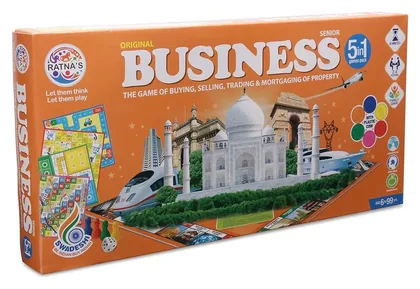
Business
India's own property game: buy cities, collect rent, build hotels
Ludo
India's favourite race game: roll a six, cut and race home
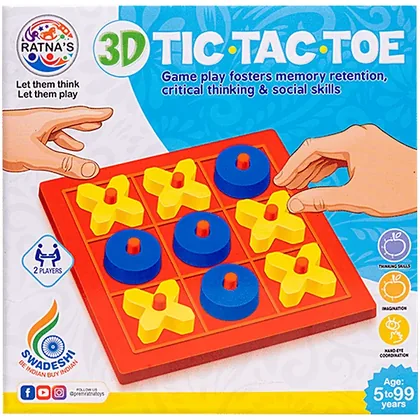
Tic Tac Toe
Three in a row wins: every child's first strategy game
Junior Crossword
Build crossing words and find a better home for every letter
International Cricket
Bowl, bat and chase runs on a cloth cricket ground at home
More tile-laying games
Different games. A familiar kind of fun.
Grammar Wise
Roll a colour, then match words to their parts of speech

Carcassonne
Build a medieval map tile by tile, then claim it
Kingdomino
Build a tiny kingdom from land dominoes in twenty minutes
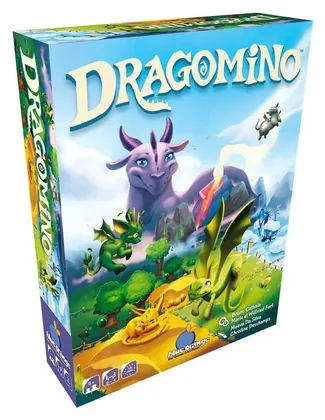
Dragomino
Kingdomino for five-year-olds: match landscapes, hatch baby dragons

Labyrinth
Shift the maze walls to reach your treasures first
Questions people ask about Dominoes
How many tiles are in a set of dominoes?
A standard double-six set has 28 tiles, one for each pairing of 0 to 6, with 168 dots in all. Bigger sets exist: double-nine has 55 tiles and double-twelve 91, for larger groups and games such as Mexican Train.
How many dominoes does each player get?
With two players, 7 each. In the block game, three or four players take 5 each; in the draw game, three players take 7 each and four take 6 each. The rest stay face down as the boneyard.
What is the difference between block and draw dominoes?
In block dominoes, a player who cannot match either end simply passes. In draw dominoes, you take tiles from the boneyard until you can play, leaving the last two there. Draw games last longer and fewer hands end blocked.
How do you score dominoes?
When a hand ends, everyone counts the dots left in their hand. The lowest total wins and scores the other players' totals minus their own; the first to 100 points (two players) or 61 (three or four) wins the game. In Muggins you also score during play whenever the two ends add up to a multiple of five.
Who goes first in dominoes?
Rules differ, so agree before you start. Many rules have players draw a tile for the lead, some make the highest double lead, and in the four-player game common in the Middle East whoever holds the double-six starts. After the first hand, the lead usually passes to the left.
Game facts
- Publisher
- Ratna's (Prem Ratna Toys, Mumbai)
- In India
- Prem Ratna Toys, Mumbai (maker of Ratna's games)
- Players
- 2–4
- Language
- No reading – Nothing to read: the tiles carry dots from 0 to 6. Children need to recognise or count up to six dots, and the scoring games add some mental arithmetic.
- Box size and weight
- 26 × 21 × 4 cm, 0.4 kg
Sources & photo creditsThe references behind this guide.
Facts on this page come from the publisher, the Indian maker or distributor, and the sources below. Photos are credited under each one.
- Domino games index (pagat.com, John McLeod)
- Block Dominoes rules (pagat.com, Joe Celko and John McLeod)
- Draw Dominoes rules (pagat.com, Joe Celko and John McLeod)
- Muggins rules (pagat.com, Joe Celko and John McLeod)
- Dominoes - Wikipedia
- Kidsinfy - Ratna's Dominoes Double 6 (store copy of the product description)
- Intertek - India Toy (Quality Control) Order 2020 approved