




Party game
Dixit
Give a clue for a dreamlike picture, but not too obvious
- Set-up
- About 2 min
- Reading
- None
The quick verdict
Full verdict ↓Great for Tables with a mix of languages, since clues can be in any language
Think twice if Your group freezes up when asked to be creative on the spot
How we rate it
Learning curve. As quick to learn as UNO: pick a card, give a clue, vote. The only twist is the scoring. Getting good at clues takes a few rounds, but the rules are lighter than Codenames, our anchor for 2.
Luck & skill. Luck and skill. Your six pictures are random, but pitching a clue that only some people get, and guessing how your friends think, is skill.
Interaction. Everyone plays a card and votes on every turn, and the fun is in reading each other's minds.
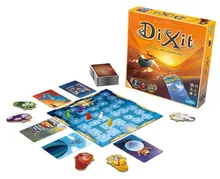
Set-up. Put the board in the middle. Each player takes a dial and a rabbit, puts the rabbit on the start of the score track, and gets six cards. There is nothing to assemble the first time, so most of the time goes on explaining the scoring.
Reading. The cards have no words. Only the rulebook needs reading, and the board's scoring reminder uses symbols.
Learning curve: 1 = UNO or Connect 4; 3 = Catan; 5 = a heavy strategy game. These describe the experience, not an overall score.
Paid link · We may earn a commission, at no extra cost to you.
Is Dixit right for you?
Great if
- Tables with a mix of languages, since clues can be in any language
- Families where older kids, parents and grandparents all want to play together
- Groups who enjoy finding out how each other's minds work
- A thoughtful gift for someone creative
Skip it if
- Your group freezes up when asked to be creative on the spot
- You want a strategy game with lots of tactical decisions
- You usually play with only two people, since it needs at least three
A place on the honours list
Good company to be in.
Recognition from beyond our table.

Spiel des Jahres
Germany’s Game of the Year: the jury’s top family-game honour.
Meet the jury’s choice ↗More recognition 2
As d'Or, Jeu de l'Année (France's Game of the Year), 2009 (Winner)
Juego del Año (Spain's Game of the Year), 2009 (Winner)
How Dixit plays
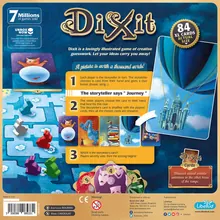
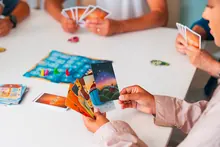
Everyone gets six large picture cards. Each turn, one player is the storyteller. The storyteller secretly picks one of their cards and gives a clue about it. The clue can be a word, a phrase, a line from a song, a sound or even a mime.
- Time to teach: about 5 minutes.
- Reading and language: The cards have no text at all. Clues can be given in any language, whether Hindi, English, Tamil or a mix, as long as everyone at the table understands them. Only the rulebook needs reading.
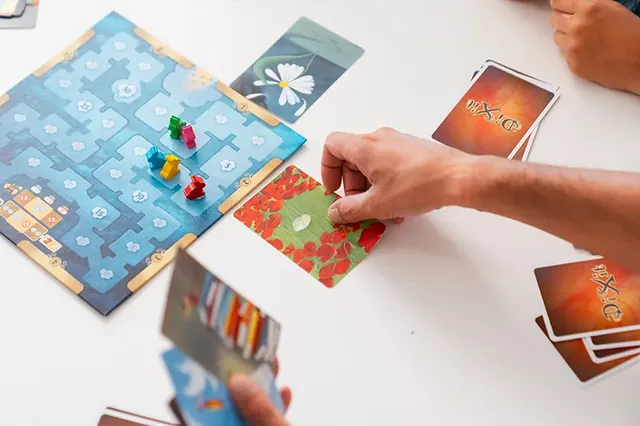
How to Play Dixit in 2 minutes · Tabletop Duo
Choose a video · Watch right here
If this creator doesn’t allow embedded playback, watch on YouTube ↗.
A turn, step by step
- 1Clue
The storyteller picks one of their six cards and says a clue for it out loud. It can be a word, a phrase, a line from a song or even a sound.
- 2Match
Everyone else secretly hands over one card that fits the clue. The storyteller shuffles them with their own and lays them out by the numbered slots on the board.
- 3Vote
Everyone except the storyteller secretly turns their dial to the card they think is the storyteller's. You can't vote for your own card.
- 4Score
If some players find it but not all, they and the storyteller score 3. If everyone or nobody finds it, the storyteller scores 0 and the rest score 2. Each vote your card attracts is worth 1 more. The first to 30 points wins.
The full explanation: how a game of Dixit goes
Every other player then picks the card from their own hand that best fits the clue and hands it face-down to the storyteller. The storyteller shuffles all the chosen cards together with their own and lays them out face-up.
Everyone except the storyteller then secretly votes for the card they think is the storyteller's. You can't vote for your own card.
Scoring is what makes the game work. If some players find the storyteller's card but not all of them, the storyteller and those players score 3 points each. If everyone finds it, or nobody does, the storyteller scores nothing and everyone else scores 2. Players also get 1 point for each vote their own card attracts. So the best clues are neither too obvious nor too vague.
Everyone draws back up to a full hand and the next player becomes storyteller. The game ends when someone reaches 30 points. With three players, everyone holds seven cards and the two players who aren't storyteller put in two cards each.
What's in the box
- 84Dixit cards
large picture cards with no words - 8Voting dials
one per player, numbered to match the card slots - 8Wooden rabbit pawns
one per player, for the score track - 1Game board
score track, 8 numbered card slots and a scoring reminder - 1Rulebook
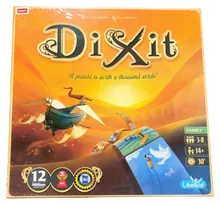
Box: 27 × 27 × 5 cm, 0.91 kg. Handy to know for gifting and travel.
This list is from Libellud's rulebook for the 2021 refresh (3-8 players), the edition Funskool imports as item 7301000. It matches Asmodee's own photo captions and an Indian listing's '84 unique cards'. Older boxes (3-6 players), which some Indian listings still describe, had 6 rabbits and 36 numbered voting tokens instead of the 8 dials, and the score track was printed on the box insert instead of a separate board.
Where to buy
Paid link · We may earn a commission, at no extra cost to you.
How to make sure you get a genuine copyEditions and the details worth checking.
What reviewers and players say
Reviewers describe Dixit as a gentle, beautiful game that wins over people who don't usually play board games. The rules fit on a page, and the big dreamlike cards get everyone talking. The clever part is the scoring: a clue that everyone gets, or nobody gets, scores the storyteller nothing, so you learn to be just vague enough. It won Germany's Spiel des Jahres in 2010. The catches: the storyteller can take a while to think of a clue, people sometimes argue over whether a clue was fair, and after many games a group starts to recognise the 84 cards. That is why Libellud sells expansion packs.
What people love
- The large, dreamlike cards are works of art and spark stories and laughter
- Simple rules and quick set-up make it a good first board game for newcomers
- The scoring rewards clues that are neither too obvious nor too vague, which makes clue-giving a real puzzle
- With no words on the cards, children, parents and grandparents can all play, in any language
Common complaints
- The storyteller can take a long time to think of a clue, so play can pause
- Once a group knows all 84 cards it can feel repetitive, so regular players buy expansions or invent house rules
- There is little long-term strategy, and the scoring can lead to friendly arguments about whether a clue was fair
Based on 6 reviews and discussions
- Review Review: Dixit (Quinns and Paul, November 2011) · Shut Up & Sit Down
- Review Dixit Board Game Review (Louise Platt, December 2013) · What's Good To Do (UK)
- Review Board Game Review: Dixit (Sam, January 2024) · Frontline Gaming
- Players Dixit variations to increase replay value? (October 2011) · Board & Card Games Stack Exchange
- Award Dixit: Spiel des Jahres 2010 · Spiel des Jahres
- Reference Dixit (board game) · Wikipedia
Summarised in our own words from the sources above. We don't use Amazon reviews or ratings.
More like Dixit
Which game is the best fit?
Our picks if Dixit isn't quite right.
Swipe to compare every game
| Compare the games.The details that make a difference. |
YOU’RE VIEWING
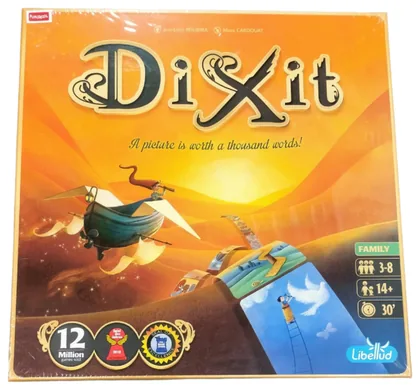 Dixit
Dixit
|
ANOTHER WAY TO PLAY
 Codenames
|
ANOTHER WAY TO PLAY
 Wavelength
|
|---|---|---|---|
| Why consider it | This game Give a clue for a dreamlike picture, but not too obvious | A different fit Another clue-giving game, played in teams and with words instead of pictures | A different fit A party game about guessing how your friends think |
| Players | 3–8 | 2–8 | 2–12 |
| Best with | 5-6 | 6-8 | 6-12 |
| Play time | 30 min | 15 min | 30–45 min |
| Age | 8+ | 14+ | 14+ |
| Rules | Easy | Easy | Easy |
| Indian edition | Imported | Imported | Imported |
| On this page | Explore Codenames | Explore Wavelength |
More from Funskool
Also made or sold in India by Funskool.
Catan
Trade wheat for brick, build roads, and race to ten points.
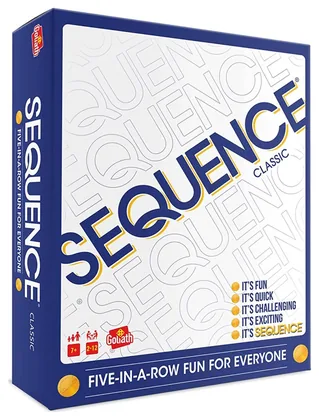
Sequence
Play a card, claim its space, and make five in a row.
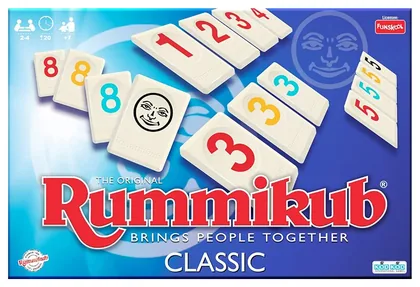
Rummikub
Rummy with tiles: build runs and groups, then rearrange the table
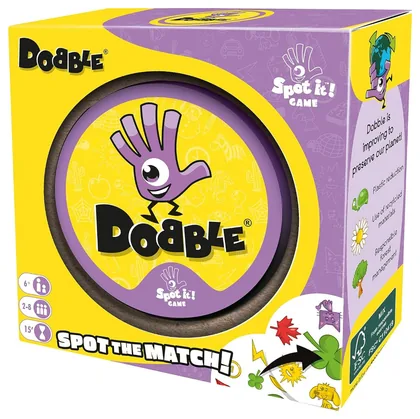
Dobble
Race to spot the one picture any two cards share
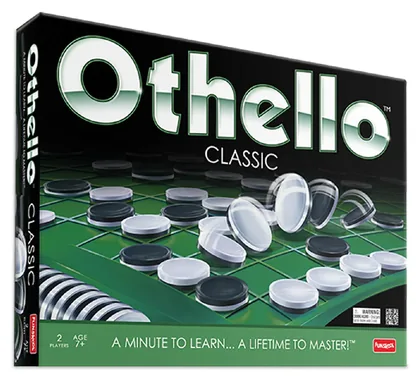
Othello
Trap a line of discs, flip them to your colour
More clue-and-guess games
Different games. A familiar kind of fun.
Codenames
One-word clues, 25 secret agents, and one assassin to avoid

Guess in 10
Ten yes-or-no questions to name the hidden animal.

Taboo
Get your team to guess the word without saying the obvious ones
Wavelength
Read your teammates' minds with one clue and a big red dial

Just One
Write one-word clues together, but matching clues get wiped out
Also playable with two
For game nights with two players.
Wavelength
Read your teammates' minds with one clue and a big red dial
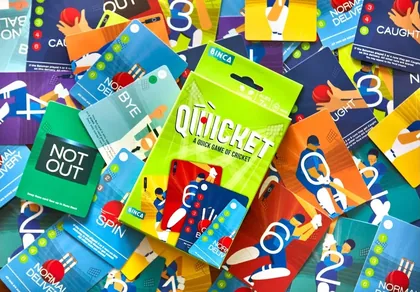
Qwicket
A two-player cricket duel over three overs, played with cards
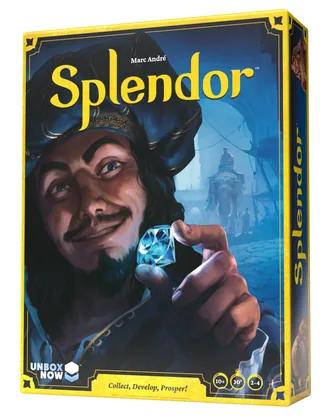
Splendor
A quick gem-trading race where every card makes the next easier.

Azul
Draft colourful tiles and build the best-scoring palace wall

Carcassonne
Build a medieval map tile by tile, then claim it
Also worth a look (not in our catalogue yet): Mysterium – Also from Libellud: a cooperative game built around dreamlike picture clues.
Questions people ask about Dixit
Is Dixit available in India?
Yes. Funskool (India) Ltd. imports and sells the current edition, the 2021 refresh for 3 to 8 players. Check that the box carries the Libellud logo, and be wary of a set that costs a fraction of the usual price.
Can Dixit be played in Hindi?
Yes. The cards have pictures only and no text, so clues can be in Hindi, English or any language your group shares. Only the rulebook needs reading.
Can 2 people play Dixit?
No. The official rules need at least 3 players. The current edition plays 3 to 8 and older boxes play 3 to 6. With three players, everyone holds seven cards and the two guessers each put in two cards.
Is Dixit good for kids?
Libellud rates it for ages 8 and up. The rules are simple; the harder part is learning to give clues that are neither too obvious nor too vague, which comes with a few rounds. Indian listings for Funskool's box differ: one shows 14+, while another shows 8+, like Libellud.
Game facts
- Designed by
- Jean-Louis Roubira
- Publisher
- Libellud (part of Asmodee)
- In India
- Funskool (India) Ltd. imports and markets the current edition
- First published
- 2008
- Players
- 3–8
- Language
- No reading – The cards have no text at all. Clues can be given in any language, whether Hindi, English, Tamil or a mix, as long as everyone at the table understands them. Only the rulebook needs reading.
- Box size and weight
- 27 × 27 × 5 cm, 0.91 kg
- Awards
- Spiel des Jahres (Germany's Game of the Year), 2010 (Winner); As d'Or, Jeu de l'Année (France's Game of the Year), 2009 (Winner); Juego del Año (Spain's Game of the Year), 2009 (Winner)
Sources & photo creditsThe references behind this guide.
Facts on this page come from the publisher, the Indian maker or distributor, and the sources below. Photos are credited under each one.