

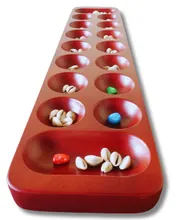
- Set-up
- About 3 min
- Reading
- None
The quick verdict
Full verdict ↓Great for Two players who like a quiet thinking game with no dice and no luck
Think twice if You want a game for three or more: Pallanguzhi is strictly for two
How we rate it
Learning curve. Sowing and capturing are learned in one game, but planning a chain of moves takes practice.
Luck & skill. No dice and nothing hidden: every capture comes from counting ahead, though long chains are hard to work out.
Interaction. Both players sow through each other's pits and capture from the same board, so every move changes what your opponent can do.
Set-up. Count five shells into each of the 14 pits (or the number you agree); the two large end pits start empty.
Reading. Nothing to read; only counting.
Learning curve: 1 = UNO or Connect 4; 3 = Catan; 5 = a heavy strategy game. These describe the experience, not an overall score.
Amazon Prime Get fast, free delivery on eligible items and early access to select sales. See Prime plans ↗
Is Pallanguzhi right for you?
Great if
- Two players who like a quiet thinking game with no dice and no luck
- Grandparents teaching grandchildren a game they grew up with, in any language
- Children practising counting: every move is counting seeds into pits, and Indian teachers have used it for arithmetic
- A wooden gift for family visits and festivals
Skip it if
- You want a game for three or more: Pallanguzhi is strictly for two
- You dislike long turns: one move can chain round the board several times
- There's a child under about 3 at home: cowrie shells and seeds are small enough to swallow
How Pallanguzhi plays
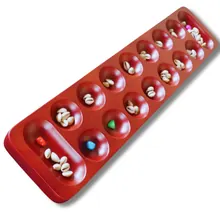
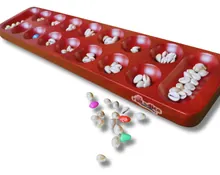
The board has two rows of seven pits, one row for each player, and many boards have a large store at each end for captured seeds. Most sets sold today are made for five seeds or cowrie shells in each of the 14 pits, 70 in all, which is why they come with 70 or more. An older record gives six per pit, and a longer version, described on Wikipedia, starts with 12 in most pits, about 146 in all.
- Time to teach: about 10 minutes.
- Reading and language: Nothing is written on the board or the shells; you only count. It's easy to teach in Tamil, Telugu, Kannada, Malayalam or any other language.
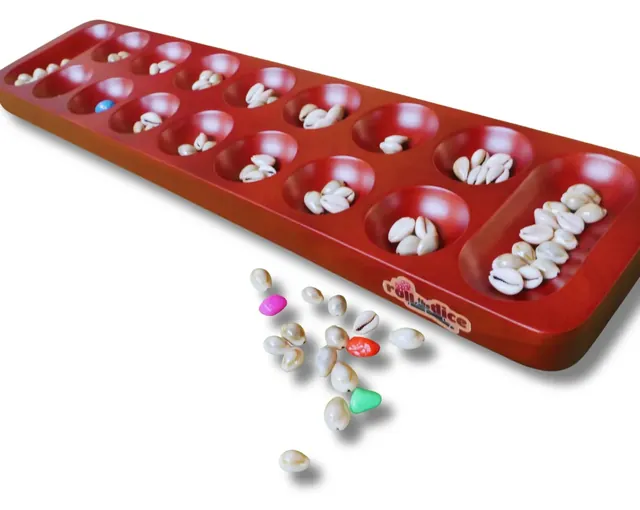
How to Play Alaguli Mane, Channe Mane, Pallanguzhi, Vamana Guntalu, Mancala · Roll the Dice India - Indian Board Games & Culture · Official
If this creator doesn’t allow embedded playback, watch on YouTube ↗.
A turn, step by step
- 1Sow
Scoop all the seeds from one of your pits and drop them one by one, anticlockwise, into the pits that follow.
- 2Continue
After the last seed, pick up the next pit and keep sowing. If the next pit is empty, capture the pit beyond it and stop.
- 3Win
When a round ends, count your captures. Play rounds until one player can't fill a single pit, or play one round: more seeds wins.
The full explanation: how a game of Pallanguzhi goes
On your turn, scoop up all the seeds in one of your pits and sow them one at a time into the following pits, anticlockwise, carrying on round your opponent's side. When you drop the last seed, pick up all the seeds in the next pit and keep sowing. If the next pit is empty, you capture the seeds in the pit just beyond it and your turn ends; if two empty pits come in a row, you capture nothing. In many rules, a pit that reaches four seeds while you sow is also taken as a capture, called pasu.
A round ends when a player has no seeds left to move, and each player counts their captures. For the full game, both players refill their own pits from their captures, the same number to a pit as at the start; any pit you can't fill is left out of play for that round. Rounds go on until one player can't fill even one pit, and the other player wins. For a quick game, play a single round: whoever has captured more seeds wins.
Rules differ from family to family and region to region: the number of seeds per pit, the count that makes a pasu, whether a capture also takes the pit opposite, and how rounds are scored. Tamil Nadu and Kerala call the game Pallanguzhi, Andhra Pradesh and Telangana Vamana Guntalu, and Karnataka Alaguli Mane or Channe Mane. Agree the house rules before the first move.
Pallanguzhi is a traditional mancala game of South India, especially Tamil Nadu and Kerala, and it travelled with Tamil families to Sri Lanka, Malaysia, Singapore, Trinidad and Guyana. Its rules were written down by 1928, in an account by Durai later collected in H. J. R. Murray's history of board games, and its cousins include Congkak in Malaysia and Indonesia and Sungka in the Philippines. Boards were traditionally carved from wood, and cowrie shells, tamarind seeds or small stones all serve as counters. Groups such as Kreeda in Chennai have worked for more than twenty years to revive it.
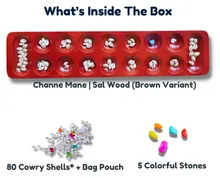
What's in the box
- 1Hardwood board
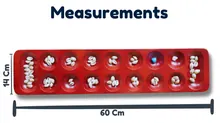
14 pits, 7 a side; about 42.7 x 7.1 x 6.8 cm and 1.08 kg (the listing's figures) - 70Seashells
- 1Storage bag
From Paljji Handicrafts' Amazon.in listing, which names a hardwood 14-pit board, 70 seashells and a storage bag and gives the size and weight. We found no website for the maker, so we haven't seen its own contents list or photos. No printed rules are listed; How it plays covers the rules.
Where to buy
Boardgames.in helps you choose a game. You place your order on Amazon.in, where you can check the seller, delivery estimate and return terms before paying. Amazon.in’s policies apply to your purchase. As an Amazon Associate, we may earn a commission when you buy through our links, at no extra cost to you.
How to pick a good setSize, pieces and the details worth checking.
Which set to buy
2 sets on Amazon.in, grouped by kind. Each button opens that set's own listing; check its size and pieces there before you buy.
Long board with shell storage2 sets

Paljji Handicrafts Hardwood Pallanguzhi with 70 Shells
Paljji Handicrafts
- Size
- About 42.7 x 7.1 x 6.8 cm, 1.08 kg (the listing's figures)
- Build
- Hard wood (the listing's material)
- In the box
- Board with storage and 70 seashells (the listing's description)
Good for: Families who want a heavy hardwood board that keeps its 70 shells, enough for five a pit
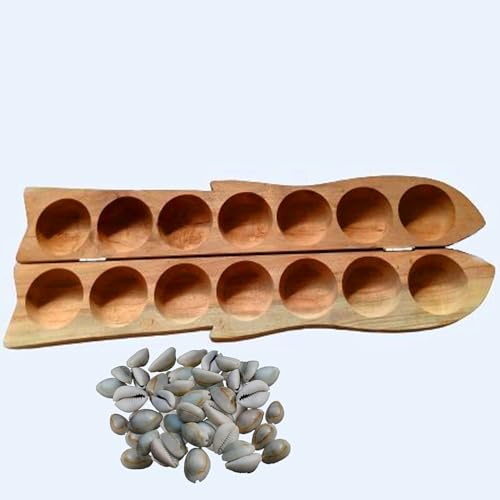
VPP Wooden Pallanguzhi with Sozhi Shells
VPP
- Size
- About 43 x 7.5 cm, 850 g (the listing's figures)
- Build
- Wood (the listing's material)
- In the box
- Board, sozhi (cowrie) shells and a storage box (the listing's description)
Good for: Tamil families who want a traditional long board with sozhi shells and a box to keep them in
What reviewers and players say
Pallanguzhi is valued as a traditional South Indian game that older generations grew up with and that parents and teachers now use to build counting and concentration. A 2007 press report describes a Hyderabad family choosing it over television and a Madurai school using it for arithmetic, and makers such as Kreeda and Roll the Dice are reviving it with new boards. Its appeal is the planning: with no dice, every capture comes from counting ahead. The usual frustrations are long chain moves that are hard to follow at first, and arguments over rules, since families play slightly different versions.
What people love
- No dice or luck: every capture comes from counting ahead
- It builds counting and concentration, so parents and teachers use it
- A game grandparents know and can pass on, in any language
- Wooden boards and shells make it a keepsake
Common complaints
- Chain moves can run round the board several times and are hard to follow at first
- Rules vary from family to family, so players must agree on them before starting
- The small shells go missing easily and must be kept from toddlers
5 research sources
- Reference Pallanguzhi (Wikipedia, read October 2026) · Wikipedia
- Review Games that sharpen your mind (Ambujam Anantharaman, December 2007) · The Tribune
- Reference Pallankuli (Ludii Portal, date not shown) · Ludii Portal, Maastricht University
- Reference Kreeda Pallanguzhi (Kreeda, date not shown) · Kreeda
- Video How to Play Alaguli Mane, Channe Mane, Pallanguzhi, Vamana Guntalu, Mancala (Roll the Dice India, date not checked) · YouTube
Summarised in our own words from the sources above. We don't use Amazon reviews or ratings.
More like Pallanguzhi
Which game is the best fit?
Our picks if Pallanguzhi isn't quite right.
Swipe to compare every game
| Compare the games.The details that make a difference. |
YOU’RE VIEWING
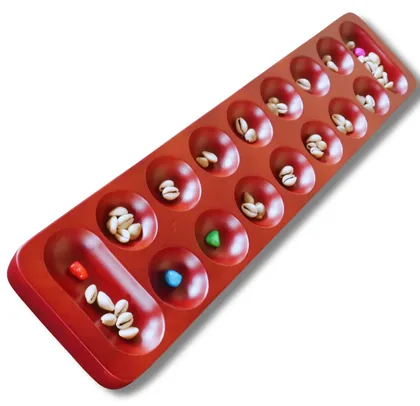 Pallanguzhi |
ANOTHER WAY TO PLAY
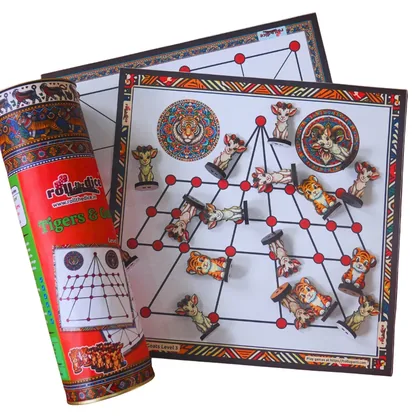 Aadu Puli Attam (Tigers and Goats) |
ANOTHER WAY TO PLAY
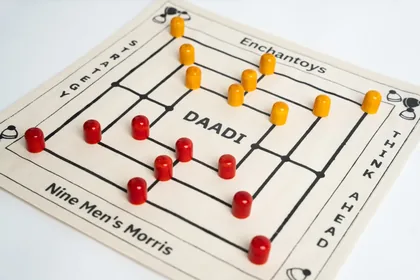 Navakankari (Nine Men's Morris) |
ANOTHER WAY TO PLAY
 Chess |
|---|---|---|---|---|
| Why consider it | This game Sow seeds round fourteen pits and capture more than your rival | A different fit Another traditional South Indian strategy game for two, with no dice: tigers hunt goats | A different fit A two-player game of lines and captures from South Indian homes, also played with no luck | A different fit The great no-luck strategy game for two, from India's Chaturanga |
| Players | 2 | 2 | 2 | 2 |
| Best with | 2 | 2 | 2 | 2 |
| Play time | 15–45 min | 10–30 min | 10–30 min | 10–60 min |
| Age | 6+ | 5+ | 6+ | 7+ |
| Rules | Easy | Easy | Easy | Medium |
| Indian edition | – | – | – | Available |
| On this page | Explore Aadu Puli Attam (Tigers and Goats) | Explore Navakankari (Nine Men's Morris) | Explore Chess |
More pure strategy games
Different games. A familiar kind of fun.
Blokus Fast Fun
A compact duel for two: fit your shapes, protect your corners, block your opponent

Connect 4
Drop discs, block your rival and get four in a row
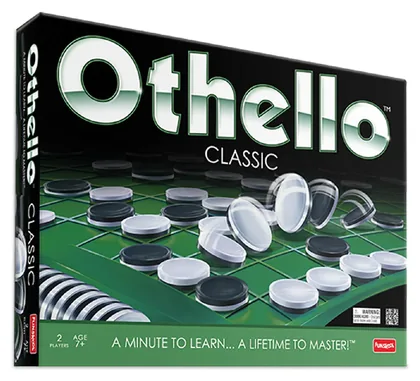
Othello
Trap a line of discs, flip them to your colour
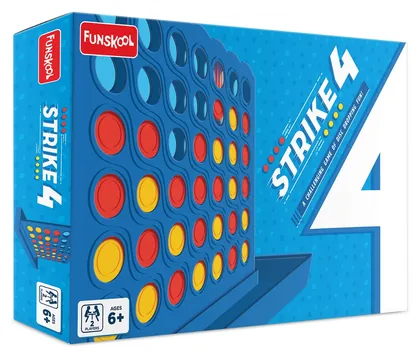
Strike 4
Drop discs, block your rival and line up four first
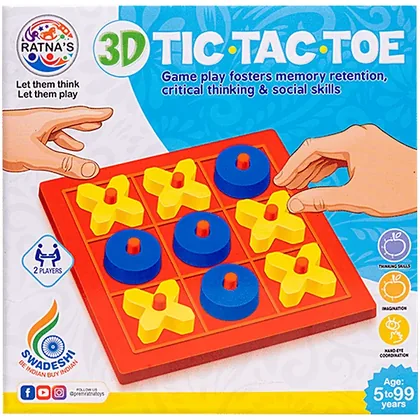
Tic Tac Toe
Three in a row wins: every child's first strategy game
Questions people ask about Pallanguzhi
What is Pallanguzhi called in other states?
It's Pallanguzhi or Pallankuzhi in Tamil Nadu and Kerala, Vamana Guntalu in Andhra Pradesh and Telangana, and Alaguli Mane, Ali Guli Mane or Channe Mane in Karnataka; Wikipedia also gives Satkoli in Marathi. The rules change a little from place to place, but it's the same 14-pit game.
How many seeds go in each pit in Pallanguzhi?
Most families and most sets today use five seeds or shells per pit, 70 in all for 14 pits. An older account gives six per pit, and a longer version starts with 12 in most pits, about 146 in all. Agree before you start, and make sure your set has enough.
Is Pallanguzhi the same as Mancala?
Mancala is the name for the whole family of pit-and-seed games, and Pallanguzhi is South India's member of it. The boxed 'Mancala' sold abroad is usually Kalah, patented in the US in the 1950s, with six pits a side, a store you sow into and different capture rules. A Pallanguzhi board has 14 pits and plays the Indian rules.
Is Pallanguzhi good for children?
Yes. Every move means counting seeds into pits and working out where the last one will land, and an Indian school has used it alongside Paramapadam to teach arithmetic. Children of about 6 can learn it; watch younger ones with the small shells.
What can I use instead of cowrie shells?
Tamarind seeds, other large seeds or small stones work just as well as cowrie shells. You need 70 counters for the common five-per-pit game, or more for the longer versions.
Game facts
- Publisher
- Paljji Handicrafts
- In India
- Paljji Handicrafts (its Amazon.in brand store)
- Players
- 2
- Language
- No reading – Nothing is written on the board or the shells; you only count. It's easy to teach in Tamil, Telugu, Kannada, Malayalam or any other language.
Sources & photo creditsThe references behind this guide.
Facts on this page come from the publisher, the Indian maker or distributor, and the sources below. Photos are credited under each one.
- Roll the Dice - Channe Mane (maker's product page)
- Roll the Dice - contact page (Trita Infotainment LLP, Mysore)
- TolluGatti (Trita Infotainment) - learn Ali Guli Mane
- Pallanguzhi - Wikipedia
- Ludii Portal (Maastricht University) - Pallankuli rules, after Durai 1928
- Kreeda - Pallanguzhi (Chennai)
- The Tribune - Games that sharpen your mind (Ambujam Anantharaman, December 2007)
- Kalah - Wikipedia
- India Briefing - BIS toy certification in India (Toys Quality Control Order)