
Family game
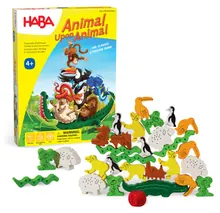
Animal Upon Animal
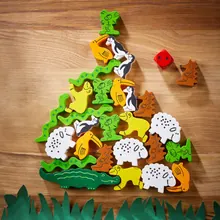
Roll the die and pile wooden animals onto a crocodile's back
- Set-up
- Under a minute
- Reading
- None
The quick verdict
Full verdict ↓Great for Children from 4 playing with grown-ups: steady hands matter more than age, so little ones can win
Think twice if There is a toddler at home who still puts things in their mouth: HABA rates it for 4 and up, and the animals are small
How we rate it
Learning curve. Roll, place, and try not to knock the pile over. A four-year-old can follow it, so it sits at 1 on our scale with UNO and Jenga.
Luck & skill. The die decides how many animals you place and whether others pick for you, but a steady hand and a good eye for where an animal will balance decide most games.
Interaction. Everyone builds the same pile, and the hand and question-mark faces let others hand you their awkward animals or choose yours.
Set-up. Put the crocodile in the middle of a flat table and give each player seven different animals.
Reading. No text on the pieces or the die. Only the rules leaflet needs reading, once.
Learning curve: 1 = UNO or Connect 4; 3 = Catan; 5 = a heavy strategy game. These describe the experience, not an overall score.
Paid link · We may earn a commission, at no extra cost to you.
Is Animal Upon Animal right for you?
Great if
- Children from 4 playing with grown-ups: steady hands matter more than age, so little ones can win
- A short game of about 15 minutes after school, or a quick round while dinner is cooking
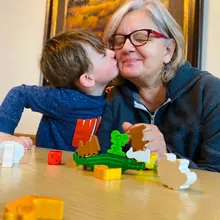
- Grandparents and grandchildren who speak different languages: there is nothing to read
- A lasting gift: HABA's colourful wooden animals are well made, which reviewers praise
Skip it if
- There is a toddler at home who still puts things in their mouth: HABA rates it for 4 and up, and the animals are small
- You want a game with more choices for older children: it is mostly steady hands and the luck of the die
- You only have a wobbly or soft surface to play on: the rules ask for a flat, even table
A place on the honours list
Good company to be in.
Recognition from beyond our table.
Spiel des Jahres jury recommendation list, 2005 (Recommended)
How Animal Upon Animal plays
Set-up: put the wooden crocodile in the middle of a flat table. It is the bottom of the pile. Each player takes seven different animals. With fewer than four players the spare animals stay in the box, or you can share them out for a longer game. HABA's rules say the player who can stand on one leg like a flamingo for longest goes first.
- Time to teach: about 2 minutes.
- Reading and language: Nothing to read during play: the die shows dots and pictures, and everything else is wooden animals. HABA's rules leaflet includes English along with German, French, Dutch, Spanish and Italian, and the game is easy to explain in any home language.

Board Game Review: Animal Upon Animal · TheBoardGameFamily
If this creator doesn’t allow embedded playback, watch on YouTube ↗.
A turn, step by step
- 1Roll
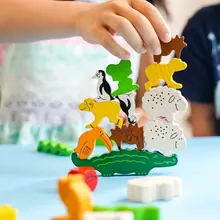
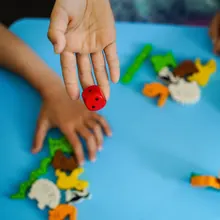
Roll the die: it tells you to place one animal, two animals, an animal beside the crocodile, give an animal to someone else, or let others choose yours.
- 2Stack
Place your animal on the pile with one hand. If one or two fall, take them back; if more fall, take two and the rest go in the box.
- 3Win
The first player to get rid of all seven of their animals wins.
The full explanation: how a game of Animal Upon Animal goes
A turn: roll the die. One dot means place one of your animals anywhere on the pile; two dots means place two, one after the other. The crocodile means put an animal on the table touching the crocodile's nose or tail, which makes the base wider. The hand means give one of your animals to another player, who has to place it. The question mark means the other players choose which of your animals you must place. Always place animals with one hand.
When things fall: if one or two animals tumble off, you take them back. If more than two fall, you take back two and the rest go in the box. If the whole pile collapses, you take two, the crocodile goes back in the middle and everything else goes in the box. The first player with no animals left wins and, says HABA, is the best animal stacker of the day.
Tips and variants: look for flat, steady spots before you place, and when you roll the hand, pass a rival your most awkward animal. For older players, HABA's rules suggest taking back up to five fallen animals instead of two, or placing your last animal without rolling. There is also a solo challenge: how many animals can you pile on the crocodile before it all comes down?
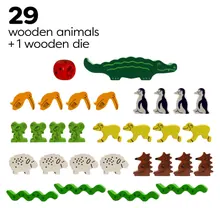
What's in the box
- 1Wooden crocodile
the base of the pile, placed in the middle of the table - 28Wooden animals
four each of toucans, sheep, snakes, monkeys, penguins, hedgehogs and lizards - 1Wooden die
shows one dot, two dots, a crocodile, a hand and a question mark - 1Rules leaflet
in German, English, French, Dutch, Spanish and Italian
Box: 0.41 kg. Handy to know for gifting and travel.
From HABA USA's page for the compact box (1 crocodile and four each of seven animals, a wooden die and instructions) and HABA's rules leaflet (29 wooden animals and 1 die with symbols). An Indian store's listing also gives 29 wooden animals and a die. Older boxes are believed to hold the same pieces, but the box we link was not checked. The Christmas tin edition has different, holiday-themed pieces.
Where to buy
Paid link · We may earn a commission, at no extra cost to you.
How to make sure you get a genuine copyEditions and the details worth checking.
What reviewers and players say
Animal Upon Animal is a long-running HABA children's game (HABA says it has sold over a million copies), and the Spiel des Jahres jury put it on its 2005 recommendation list. A family review praises the sturdy, colourful wooden animals, the quick setup and the die, which gives young children a real chance to beat their parents; the family say it is hard to play just once. One board game writer calls it a family favourite for years, while another prefers a later version with extra twists. Its limits are simple: it is mostly dexterity and luck, so older children may move on to tougher stacking games.
What people love
- Chunky, colourful wooden animals in HABA's usual sturdy quality
- Quick to set up and short to play, so families start another round straight away
- The die gives small children a real chance to win against grown-ups
- Silly, wobbly stacks are fun even for players who don't mind who wins
Common complaints
- Some fans prefer later versions, such as Here We Turn with its tipping platform, for more of a challenge
- With two or three players only seven animals each are used, so part of the set sits in the box unless you play HABA's variant
- It needs a flat, steady table; a soft or uneven surface makes the pile fall too easily
Based on 5 reviews and discussions
- Award Tier auf Tier, 2005 recommendation (jury page) · Spiel des Jahres
- Review Animal Upon Animal is a fun Kids Game (Trent, June 2015) · The Board Game Family
- Review 10 Great Animal Games (Chris Wray, June 2020) · The Opinionated Gamers
- Reference Animal Upon Animal Stacking Game (HABA USA product page) · HABA USA
- Reference Animal Upon Animal game instructions (HABA) · HABA
Summarised in our own words from the sources above. We don't use Amazon reviews or ratings.
More like Animal Upon Animal
Which game is the best fit?
Our picks if Animal Upon Animal isn't quite right.
Swipe to compare every game
| Compare the games.The details that make a difference. |
YOU’RE VIEWING
 Animal Upon Animal
|
ANOTHER WAY TO PLAY
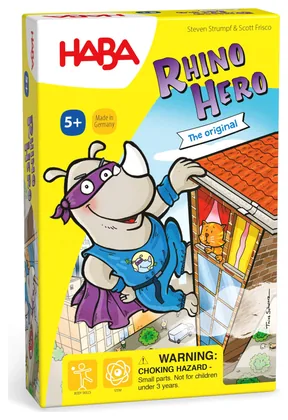 Rhino Hero
|
ANOTHER WAY TO PLAY
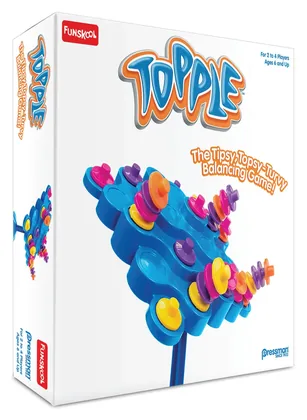 Topple
|
ANOTHER WAY TO PLAY
 Jenga
Jenga
|
|---|---|---|---|---|
| Why consider it | This game Roll the die and pile wooden animals onto a crocodile's back | A different fit HABA's other wobbly stacking game, building a tower from card walls and roofs | A different fit Roll a die and stack pieces on a tower that tips and sways | A different fit The classic steady-hands tower game, for slightly older children |
| Players | 2–4 | 2–5 | 2–4 | 1–8 |
| Best with | 3-4 | 3-5 | 3-4 | 3-5 |
| Play time | 10–15 min | 5–15 min | 15–30 min | 5–15 min |
| Age | 4+ | 5+ | 6+ | 6+ |
| Rules | Easy | Easy | Easy | Easy |
| Indian edition | Imported | Imported | Available | Available |
| On this page | Explore Rhino Hero | Explore Topple | Explore Jenga |
More from HABA
Another way into their collection.
More steady-hands games
Different games. A familiar kind of fun.
Topple
Roll, stack and score on a tower that tips and sways
Jenga
Pull a block, stack it on top, don't topple the tower
Rhino Hero
Build a wobbly card skyscraper without toppling the rhino
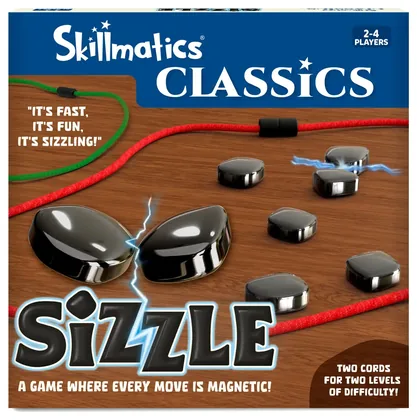
Sizzle
Place magnets inside a loop without letting them snap together.
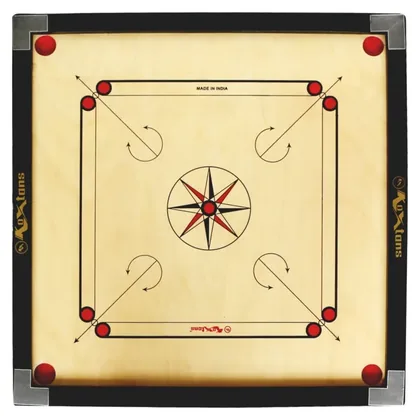
Carrom
Flick the striker, pocket your colour, then capture and cover the queen
Also playable with two
For game nights with two players.
Sizzle
Place magnets inside a loop without letting them snap together.
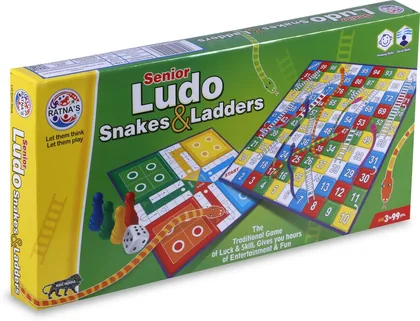
Snakes and Ladders
Climb the ladders, dodge the snakes, first to 100 wins
Carrom
Flick the striker, pocket your colour, then capture and cover the queen
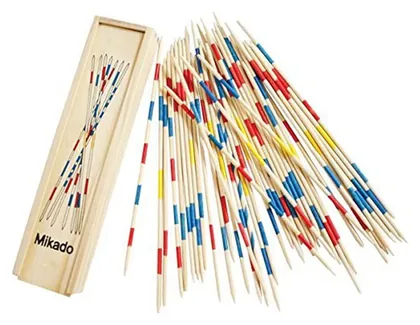
Mikado
Drop the sticks, then lift them one by one without a wobble
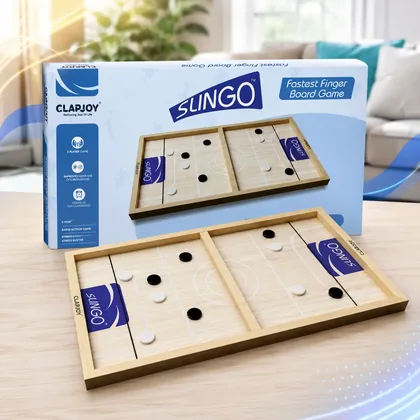
Sling Puck
Two players, ten pucks, one slot: clear your side first
Also worth a look (not in our catalogue yet): Animal Upon Animal Junior – HABA's simpler stacking set for children from 2.
Questions people ask about Animal Upon Animal
What age is Animal Upon Animal for?
HABA's rules say ages 4 to 99. Four-year-olds can play properly with a grown-up beside them, and adults enjoy it too because a steady hand matters more than age. The wooden animals are small, so keep them away from toddlers.
How many animals come in Animal Upon Animal?
There are 29 wooden animals: one crocodile, which forms the base, and four each of toucans, sheep, snakes, monkeys, penguins, hedgehogs and lizards. There is also a wooden die. Each player uses seven animals, one of each kind.
Is Animal Upon Animal made in India?
No. It's an imported HABA game, and there is no Indian edition.
What is the difference between Animal Upon Animal and Rhino Hero?
Both are HABA stacking games. In Animal Upon Animal you pile wooden animals onto a crocodile, and it suits children from 4. In Rhino Hero you build a card tower with wall and roof cards and climb it with a wooden rhino, and it is rated for 5 and up.
Can a child play Animal Upon Animal alone?
Yes. HABA's rules include a solo challenge: see how many animals you can pile on the crocodile before the stack collapses, then try to beat your record.
Game facts
- Designed by
- Klaus Miltenberger
- Publisher
- HABA, Germany
- First published
- 2005
- Players
- 2–4
- Language
- No reading – Nothing to read during play: the die shows dots and pictures, and everything else is wooden animals. HABA's rules leaflet includes English along with German, French, Dutch, Spanish and Italian, and the game is easy to explain in any home language.
- Box size and weight
- 0.41 kg
- Awards
- Spiel des Jahres jury recommendation list, 2005 (Recommended)
Sources & photo creditsThe references behind this guide.
Facts on this page come from the publisher, the Indian maker or distributor, and the sources below. Photos are credited under each one.
- HABA USA - Animal Upon Animal Stacking Game (compact version, item 3678AUA)
- HABA - Animal Upon Animal game instructions (PDF)
- Spiel des Jahres - Tier auf Tier (jury page, 2005 recommendation)
- HABA USA - Animal Upon Animal Christmas Stacking Game
- HABA USA - My Very First Games: Animal Upon Animal Junior
- The Board Game Family - Animal Upon Animal review (June 2015)
- Board Games India - Animal Upon Animal (HABA)